
On a timeline
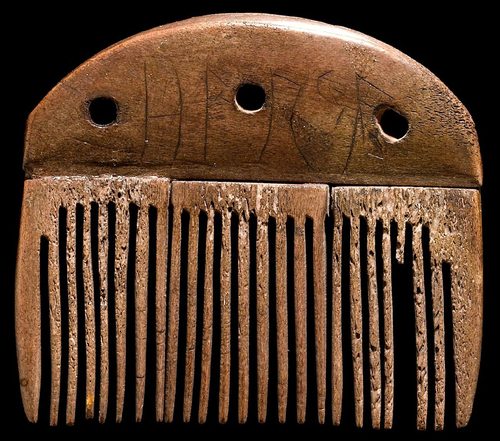
Vimose comb
An antler comb from a Danish bog with the word harja: one of the oldest runic inscriptions that can be dated, from the middle of the 2nd century AD.
Elder Futhark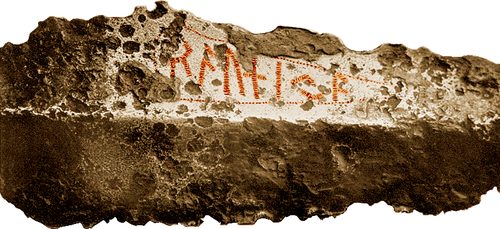
Øvre Stabu spearhead
An iron spearhead from a Norwegian grave with the runes raunijaz, 'tester': one of the oldest runic inscriptions, naming the weapon itself.
Elder Futhark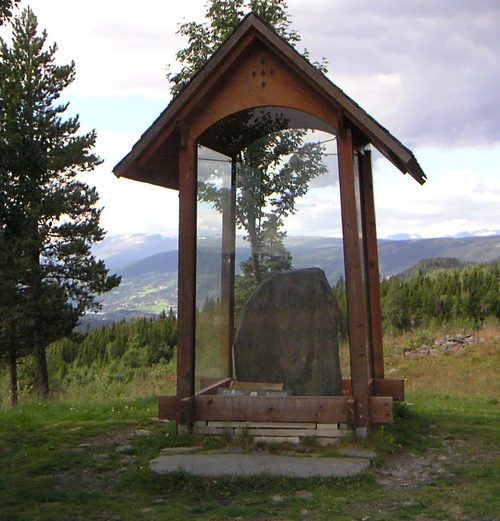
Einang stone
A 4th-century Norwegian runestone still on its grave mound; its carver 'painted the rune', an early certain use of the word runo.
Elder Futhark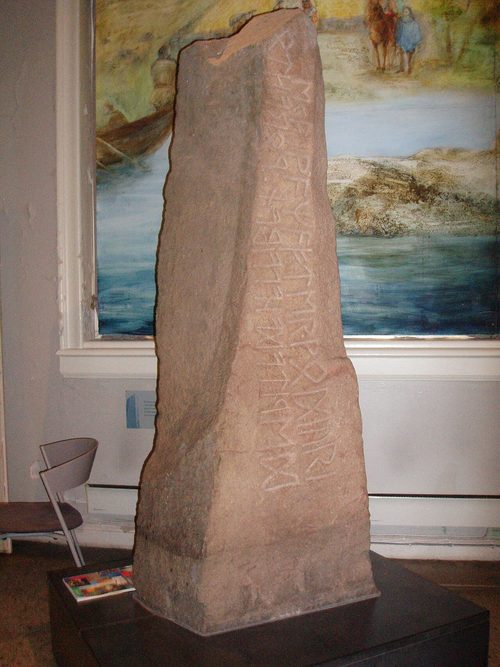
Tune stone
A Norwegian runestone of the 3rd–5th century, one of the longest Proto-Norse texts: a memorial that mentions three daughters and an inheritance.
Elder Futhark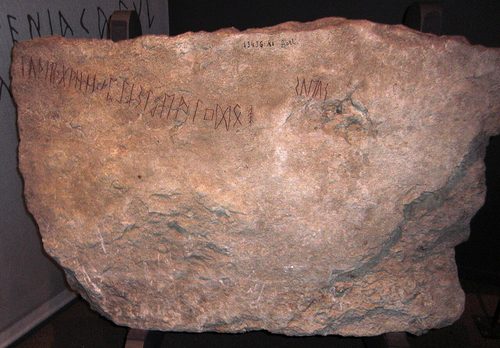
Kylver stone
A Gotland grave slab from about AD 400 carrying the oldest complete listing of the 24-rune Elder Futhark, in its own order.
Elder Futhark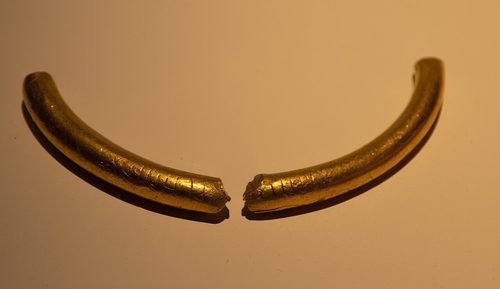
Ring of Pietroassa
A gold neck-ring from a Gothic hoard found in Romania in 1837, with runes naming the Goths and calling it holy; cut by a thief in 1875.
Elder Futhark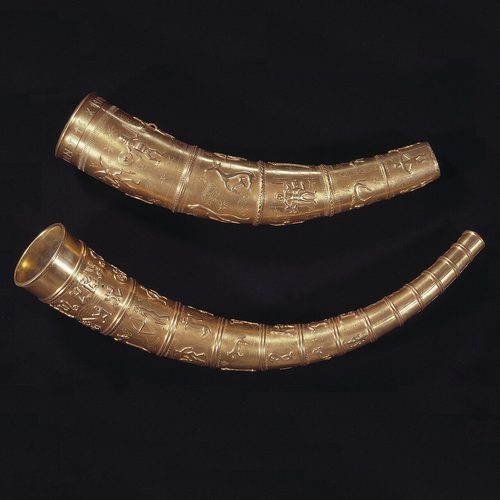
Golden horns of Gallehus
Two gold horns found in Denmark in 1639 and 1734 and melted down in 1802; one bore the line ek hlewagastiz holtijaz horna tawido.
Elder FutharkUndley bracteate
A small gold bracteate from Suffolk, c. 450–500, with a she-wolf and twins and a runic legend that may be the earliest text in (pre-)Old English.
Anglo-Saxon Futhorc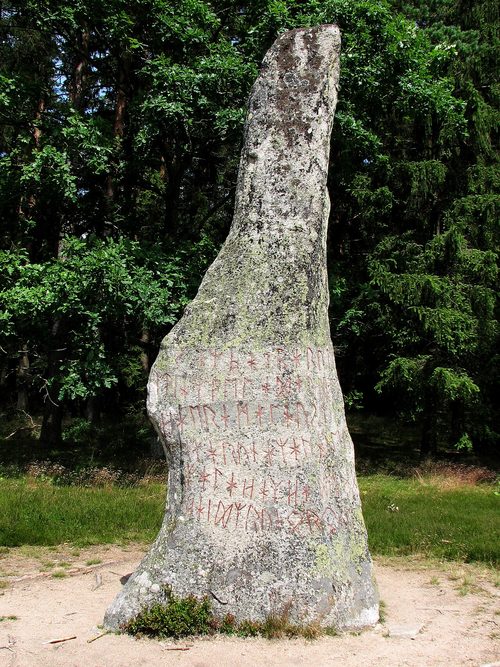
Björketorp runestone
A 4-meter runestone in Blekinge from about the 7th century, carved with a curse on anyone who breaks the monument and the words 'prophecy of ruin'.
Elder Futhark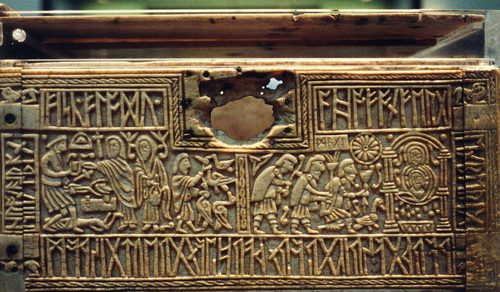
Franks Casket
An 8th-century Northumbrian box of whale bone, carved with Weland, the Magi, Rome and Jerusalem, and inscribed in runes, Old English and Latin.
Anglo-Saxon Futhorc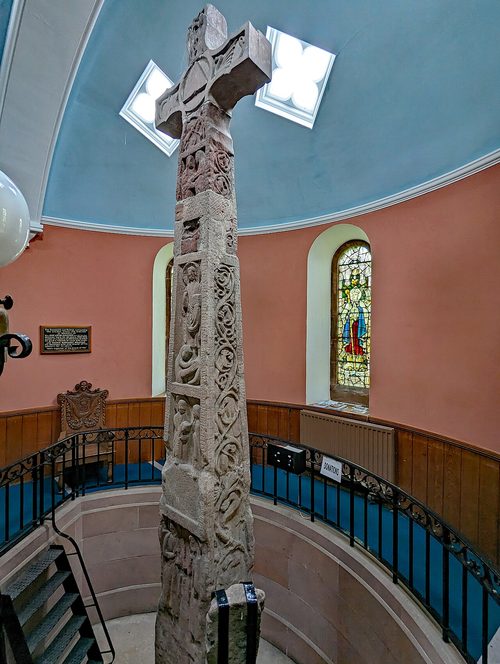
Ruthwell Cross
An 8th-century Northumbrian cross in Scotland carved with verses of The Dream of the Rood in runes, among the oldest English poetry.
Anglo-Saxon Futhorc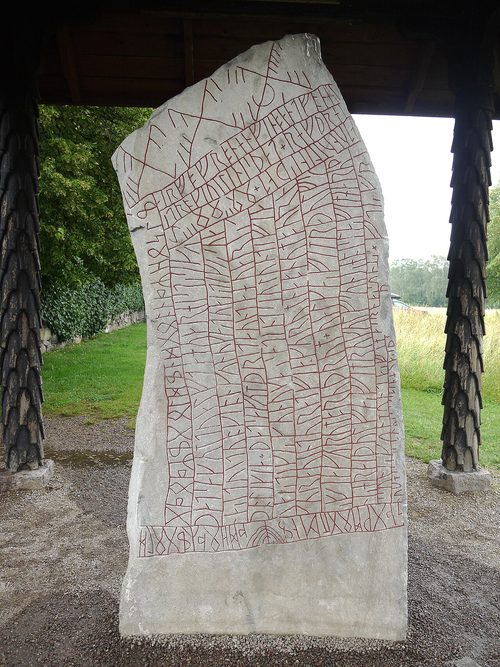
Rök runestone
The longest runic inscription on stone, about 760 runes, raised by Varinn for his dead son in early 9th-century Sweden; its riddles are still argued over.
Younger Futhark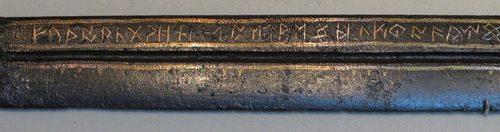
Seax of Beagnoth
A 10th-century Anglo-Saxon long knife from the Thames, inlaid with the only complete 28-rune futhorc row known from an inscription, and the name Beagnoth.
Anglo-Saxon Futhorc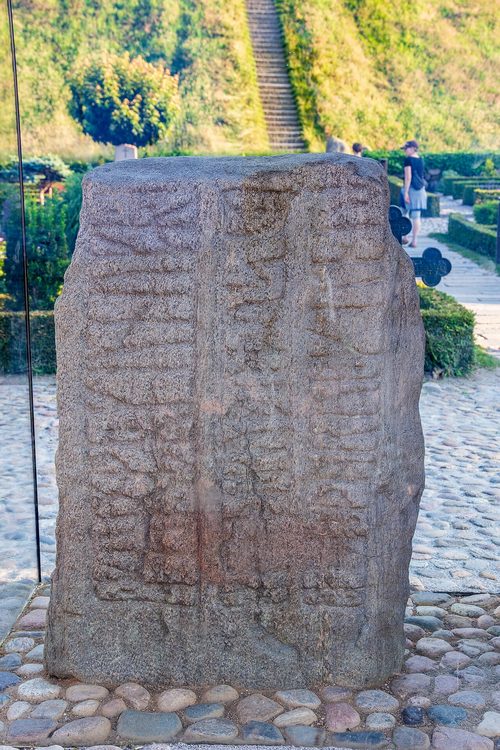
Small Jelling stone (Gorm's stone)
The smaller Jelling runestone, raised by King Gorm the Old for his wife Thyra in the mid-10th century, with an early mention of 'Denmark' on Danish soil.
Younger Futhark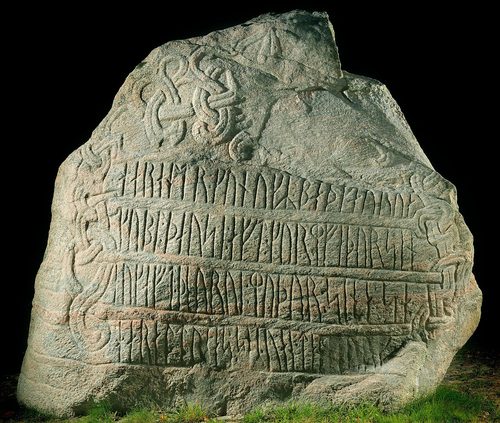
Large Jelling stone (Harald's stone)
Harald Bluetooth's runestone at Jelling, c. 965–985: 'who won all Denmark and Norway and made the Danes Christian'.
Younger Futhark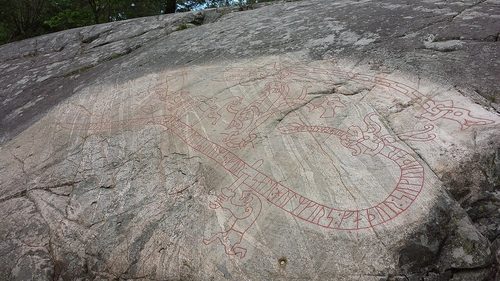
Ramsund carving (Sigurd carving)
A Swedish rock carving of about 1030 showing Sigurd killing the dragon Fáfnir; the runes inside the serpent record a bridge built for a man's soul.
Younger Futhark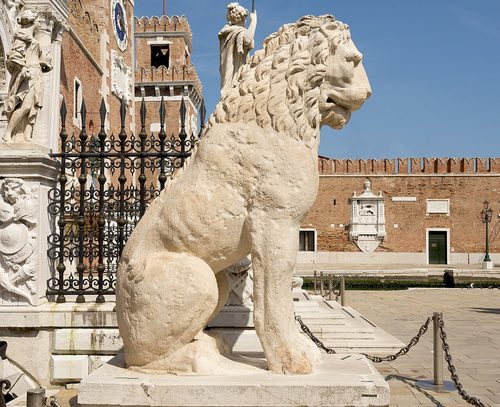
Piraeus Lion
An ancient marble lion from Piraeus, carved with runes by Scandinavians in the 11th century and taken to Venice in 1687.
Younger Futhark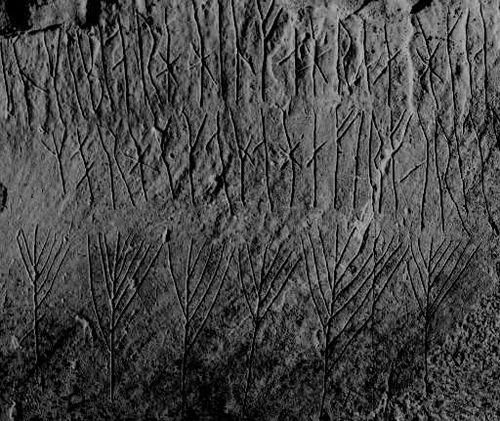
Maeshowe runic inscriptions
About thirty Norse runic graffiti cut in the 12th century inside Maeshowe, an Orkney tomb: boasts, jokes, treasure tales, crusaders.
Medieval runes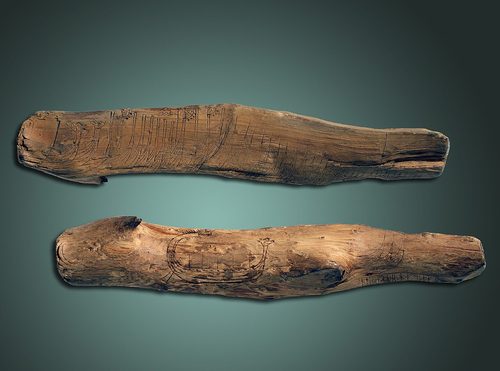
Bryggen rune-sticks
About 670 medieval rune-sticks from Bergen's wharf, c. 1150–1350: love notes, owner's tags, business letters, Latin verses and a wife's 'come home'.
Medieval runes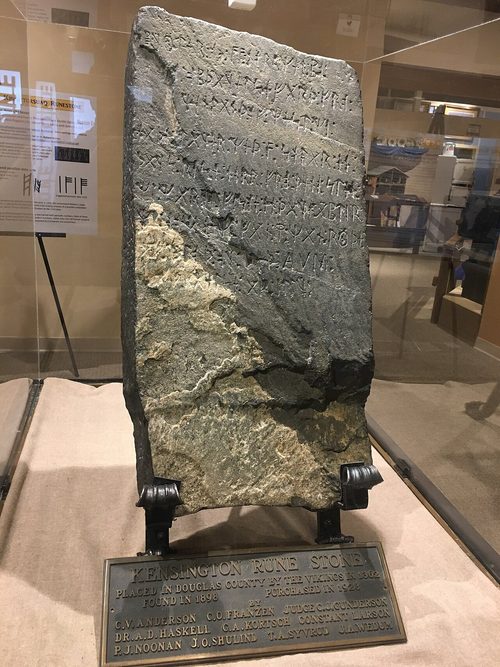
Kensington Runestone
A Minnesota stone 'found' in 1898 claiming a Norse expedition of 1362. Runologists and linguists agree it was carved in the 19th century.
19th-century creationAll inscriptions in a table
| Inscription | Signum | Date | Script | Found | Now |
|---|---|---|---|---|---|
| Vimose comb | DR 207 | c. 140–160 AD (archaeological dating); often given as c. 160 | Elder Futhark | Vimose bog, Allese parish, northwest Funen, Denmark | National Museum of Denmark, Copenhagen |
| Øvre Stabu spearhead | N KJ31 | late 2nd or early 3rd century AD (archaeological dating; RuneS gives c. 210–240) | Elder Futhark | Øvre Stabu farm, Østre Toten Municipality, Innlandet, Norway | Museum of Cultural History, Oslo |
| Einang stone | N KJ63 | probably 4th century AD (RuneS gives late 2nd to early 5th century from the grave field) | Elder Futhark | Einang, Gardberg grave field, Vestre Slidre Municipality, Valdres, Innlandet, Norway | Still standing on its grave mound at Einang, under a glass and timber shelter |
| Tune stone | N KJ72 | c. 200–450 AD; RuneS gives 200–400, with a 3rd-century date thought most likely if it stood by a rich grave | Elder Futhark | Churchyard wall of Tune church, Østfold, Norway | Museum of Cultural History (Kulturhistorisk museum), Oslo |
| Kylver stone | G 88 | c. 400 AD (from the grave it covered) | Elder Futhark | Kylver farm, Stånga parish, Gotland, Sweden | Swedish History Museum (Historiska museet), Stockholm |
| Ring of Pietroassa | — | late 4th or first half of the 5th century AD (date of the hoard; estimates vary) | Elder Futhark | Istrița hill near Pietroasele (formerly Pietroassa), Buzău County, Romania | National Museum of Romanian History, Bucharest |
| Golden horns of Gallehus | DR 12 | early 5th century AD (c. 400–450 on archaeological and art-historical grounds) | Elder Futhark | Gallehus, near Møgeltønder, Tønder Municipality, South Jutland, Denmark | Lost: stolen and melted down in 1802. Replicas are in the National Museum of Denmark, Copenhagen |
| Undley bracteate | — | second half of the 5th century AD (c. 450–500) | Anglo-Saxon Futhorc | Undley Common, near Lakenheath, Suffolk, England | British Museum, London |
| Björketorp runestone | DR 360 | 6th–7th century AD; most scholars favor the 7th century | Elder Futhark | Björketorp, Listerby parish, about 7 km east of Ronneby, Blekinge, Sweden | Standing at its site, with two tall uninscribed stones, beside an Iron Age grave field |
| Franks Casket | — | first half of the 8th century AD (c. 700–750) | Anglo-Saxon Futhorc | Made in Anglo-Saxon England (probably Northumbria); surfaced in the 19th century at Auzon, Haute-Loire, France | British Museum, London (front, back, left side and lid); right side in the Museo Nazionale del Bargello, Florence |
| Ruthwell Cross | — | 8th century AD; the runes perhaps c. 750 | Anglo-Saxon Futhorc | Ruthwell, Dumfriesshire (Dumfries and Galloway), Scotland; then in the Anglo-Saxon kingdom of Northumbria | Inside Ruthwell parish church, in an apse built for it in 1887 |
| Rök runestone | Ög 136 | early 9th century AD | Younger Futhark | Rök church, Ödeshög Municipality, Östergötland, Sweden | Standing beside Rök church, under a protective roof (on this spot since 1933) |
| Seax of Beagnoth | — | 9th or 10th century AD (usually given as 10th century) | Anglo-Saxon Futhorc | River Thames at Battersea, London, England | British Museum, London |
| Small Jelling stone (Gorm's stone) | DR 41 | mid-10th century AD (before Gorm's death, c. 958) | Younger Futhark | Jelling, Vejle Municipality, Jutland, Denmark | In front of Jelling church, between the two great mounds, in a climate-controlled glass case |
| Large Jelling stone (Harald's stone) | DR 42 | c. 965–985 AD (after Harald's conversion, which is usually placed in the 960s, and before his death c. 985) | Younger Futhark | Jelling, Vejle Municipality, Jutland, Denmark | In front of Jelling church, midway between the two great mounds, in a climate-controlled glass case |
| Ramsund carving (Sigurd carving) | Sö 101 | c. 1030 AD | Younger Futhark | Ramsundsberget, near Sundbyholm, Jäder parish, Eskilstuna Municipality, Södermanland, Sweden | In place, carved on bedrock at Ramsundsberget |
| Piraeus Lion | By NT1984;32 | 11th century AD; the right-side band probably last quarter of the 11th century | Younger Futhark | Harbor of Piraeus, Athens, Greece (where the runes were carved) | Outside the entrance of the Arsenale, Venice, Italy (since 1687–88); plaster cast in the Swedish History Museum, Stockholm |
| Maeshowe runic inscriptions | Br Barnes1–33 | mid-12th century AD, probably around 1150–1153 (with more than one visit) | Medieval runes | Maeshowe chambered cairn, Stenness, Mainland Orkney, Scotland | In place, on the walls of the Neolithic chamber (Historic Environment Scotland site) |
| Bryggen rune-sticks | N B1–N B6xx (Bryggen series) | c. 1150–1350 AD; some 14th-century | Medieval runes | Bryggen, the medieval wharf of Bergen, Vestland, Norway | Bryggens Museum, Bergen (University Museum of Bergen collections) |
| Kensington Runestone | — | presented in 1898; the text claims the year 1362. Scholarly consensus: carved in the 19th century | Modern (19th c.) | Olof Ohman's farm, Solem Township, Douglas County, Minnesota, USA (near Kensington) | Runestone Museum, Alexandria, Minnesota |
Signa are the numbers of the Scandinavian Runic-text Database and the national corpora (DR Denmark, N Norway, Ög Östergötland, Sö Södermanland, U Uppland, G Gotland, Or Orkney).