
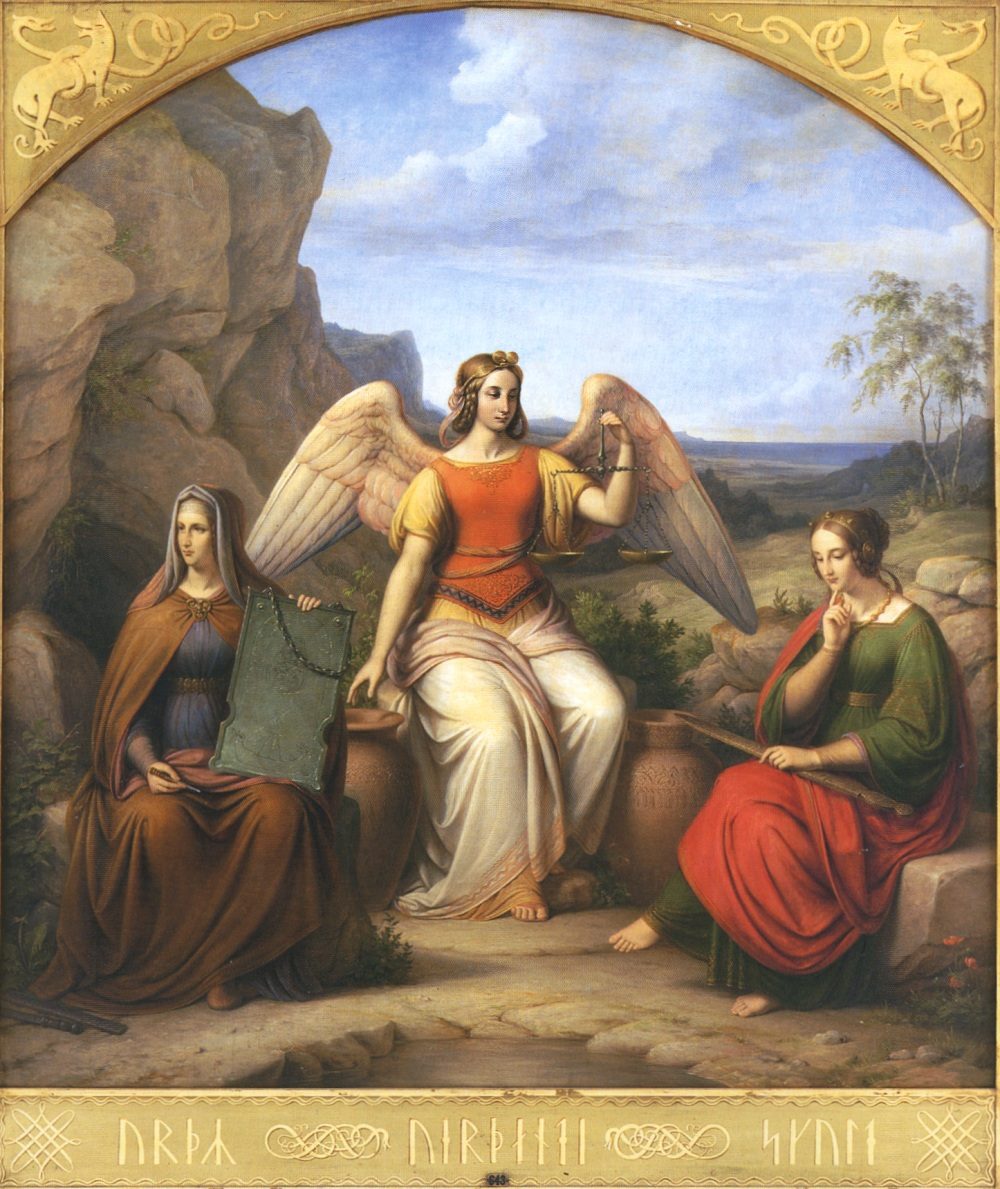

One word, two languages
Old English wyrd, Old Saxon wurd, Old High German wurt and Old Norse urðr go back to a reconstructed Proto-Germanic *wurþiz, a noun formed from the verb *werþaną, "to become, to happen" (Old English weorþan, Old Norse verða, modern German werden). The basic sense is "what has come about": an event, a fate, an outcome, often a death. Old Norse lost the initial w- before u, which is why the Norse form starts with a vowel.
The other two Norn names in Norse tradition are ordinary words too. Verðandi is the present participle of verða, "becoming, happening". Skuld is the word for a debt or obligation, from the verb skulu, "shall, must". A popular modern reading turns the three into Past, Present and Future. That idea rests on the grammar of the names; neither the poem that names them nor Snorri Sturluson says it, and scholars treat it as an interpretation rather than a source.
The Norns at the well: Völuspá
The seeress's poem Völuspá, preserved in the Codex Regius (written around 1270) and in Hauksbók, describes the world-tree and the well beneath it:
Ask veit ek standa, / heitir Yggdrasill, / hár baðmr, ausinn / hvíta auri; / þaðan koma döggvar, / þærs í dala falla, / stendr æ yfir grænn / Urðarbrunni. An ash I know standing, called Yggdrasill, a high tree, washed with white clay; from there come the dews that fall in the valleys; it stands ever green over Urðr's well.Völuspá 19
Þaðan koma meyjar / margs vitandi / þrjár ór þeim sæ, / er und þolli stendr; / Urð hétu eina, / aðra Verðandi, / — skáru á skíði — / Skuld ina þriðju; / þær lög lögðu, / þær líf kuru / alda börnum, / örlög seggja. From there come maidens who know many things, three, out of the lake that lies under the tree. One they called Urðr, the second Verðandi (they cut into a slip of wood), Skuld the third. They laid down laws, they chose lives for the children of men, the fates of men.Völuspá 20
Three details matter. The Norns choose (kuru) lives and lay down (lögðu) laws: fate is a decision made by someone, not an impersonal force. They cut into a slip of wood (skáru á skíði), an image of carving, perhaps marks or runes on a tally-stick; the poem does not say which. And the word for fate here is örlög, literally "primal laws", the usual Old Norse term, not urðr itself.
Verðandi is named nowhere in Old Norse literature outside this stanza and Snorri's retelling of it. Skuld also appears among the valkyries in Völuspá 30. Some editors have wondered whether the lines naming all three are original; the question cannot be settled from the two manuscripts.
Snorri's Norns
Snorri Sturluson's Gylfaginning (around 1220), chapter 15, builds on the poem and adds a good deal:
Þar stendr salr einn fagr undir askinum við brunninn, ok ór þeim sal koma þrjár meyjar, þær er svá heita: Urðr, Verðandi, Skuld. Þessar meyjar skapa mönnum aldr. Þær köllum vér nornir. Enn eru fleiri nornir, þær er koma til hvers barns, er borit er, at skapa aldr … A fair hall stands under the ash by the well, and out of that hall come three maidens, who are called Urðr, Verðandi, Skuld. These maidens shape the lifetimes of men. We call them norns. There are also more norns, who come to every child that is born, to shape its lifetime …Gylfaginning 15
Snorri goes on to say that some norns are of the gods' kin, some of the elves' and some of the dwarfs', quoting Fáfnismál 13, and that "good norns of good descent shape a good life, but when people meet misfortune, evil norns cause it". He also has the Norns water the ash every day with water and clay from the well so that its limbs do not rot. The three-Norn scheme is therefore Snorri's systematisation of a poem; the wider tradition is of many norns.
Norns in the heroic poems
The heroic poems of the Edda use norns as the givers of a person's lot, usually a hard one:
- Fáfnismál 12–13: Sigurðr asks the dying dragon which norns help women in childbirth; Fáfnir answers that the norns are "of very different birth", some of the Æsir, some of the elves, some "daughters of Dvalinn", a dwarf.
- Reginsmál 2: the dwarf Andvari, forced to live as a pike, says aumlig norn skóp oss í árdaga, at ek skylda í vatni vaða, "a wretched norn shaped us in days of old, that I should wade in water".
- Helgakviða Hundingsbana I 2–4: on the night the hero Helgi is born, norns come to the house, shape his fate, and twist and fasten the threads of his destiny across the sky.
- Hamðismál 30, the last words of the doomed brothers: kveld lifir maðr ekki eftir kvið norna, "no one lives an evening past the norns' verdict".
Runes and norns meet once in the poems: in Sigrdrífumál 17, in a list of the places where runes were carved in mythic time, is á nornar nagli, "on the norn's nail".
Wyrd in Old English poetry
Old English has no named Norns, but it has wyrd, and its poets use it often. Some of the best-known lines:
Gǣð ā wyrd swā hīo scel.Fate always goes as it must.Beowulf 455, Beowulf to Hrothgar
Wyrd oft nereð / unfǣgne eorl, þonne his ellen dēah.Fate often spares a man not yet doomed, when his courage holds.Beowulf 572–573
wyrd bið ful ārǣdfate is wholly fixedThe Wanderer 5
Wyrd biþ swīþre, / meotud meahtigra / þonne ǣnges monnes gehygd.Fate is stronger, the Measurer mightier, than any man's thought.The Seafarer 115–116
Whether wyrd in these poems is a pagan survival, a personified power, or simply a word for "the course of events" under a Christian God is one of the long debates of Old English studies. B. J. Timmer (1941) argued that it had become little more than "event" or "fate" in a Christian sense; others have read more of an older goddess into it. The poems themselves usually set wyrd beside God: in The Seafarer, meotud, "the Measurer", is God. In King Alfred's Old English version of Boethius's Consolation of Philosophy (late 9th century), wyrd translates Latin fatum and fortuna and is placed explicitly under God's providence (foreþonc).
From wyrd to weird
The word lived on in Middle English and Scots as werd, weird, "fate, destiny". Scottish chronicles of the 15th and 16th centuries told of three women who met Macbeth and foretold his kingship; Raphael Holinshed's Chronicles (1577), retelling the story, calls them "the weird sisters, that is (as ye would say) the goddesses of destinie". Shakespeare took them into Macbeth (around 1606). Because of the play, weird came to suggest the uncanny, and from the early 19th century it came to mean simply "strange", which is the sense it has today.
What the sources do not say
- No source describes the Norns weaving, though Helgakviða has them twisting and fastening threads, and the image of spinning fate is shared with the Greek Moirai and Roman Parcae. Comparisons with those, and with the three matronae of Roman-era Germanic inscriptions, are scholarly hypotheses.
- No medieval source links the Norns to rune divination. The "Wyrd rune", a blank tile in modern rune sets, was introduced by Ralph Blum in 1982; see where modern rune meanings came from.
- "The web of wyrd" as a cosmic network is a modern phrase, popularised in the late 20th century, not an Old English one.