

What to notice
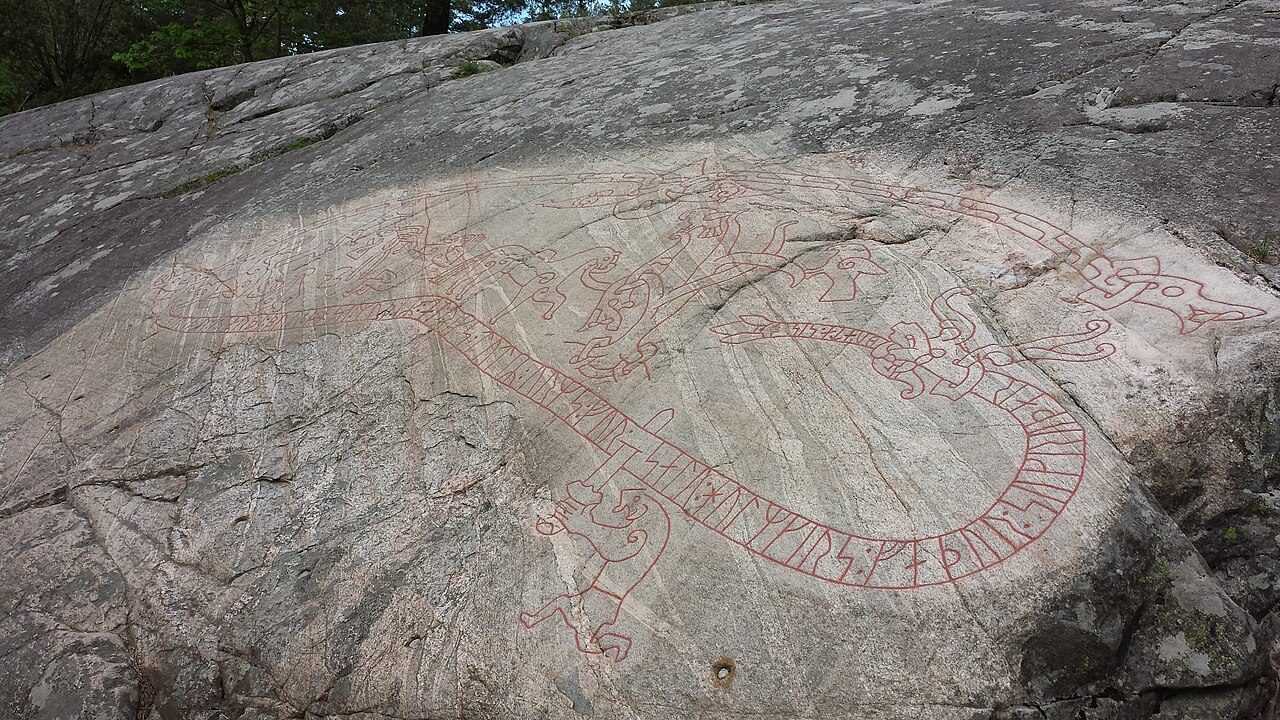
- Sigurd stabs the dragon from below: the rune band is the dragon
- Reginn's smithing tools, Grani with the gold, the birds, the otter
- The text is a Christian bridge inscription 'for the soul'
- Carved on bedrock, not on a raised stone
The Ramsund carving is cut into a flat face of bedrock on Ramsundsberget, near Sundbyholm on the shore of Lake Mälaren in Södermanland, Sweden. It is listed with the runestones as Sö 101 but is not a raised stone: the whole picture, about 4.7 m long, lies on the living rock. It was made around 1030 and is the finest of a group of Swedish carvings that show the legend of Sigurd the dragon-slayer, Old Norse Sigurðr Fáfnisbani.
The picture
The design is framed by two serpents. The lower one carries the runes in its body; at the right its head meets the upper serpent. Between them, scenes from the story are arranged in a loop that moves backward and forward in time:
- Sigurd kills Fáfnir. At the bottom, Sigurd stands in a pit and drives his sword up through the serpent's body; the runic band itself is the dragon he pierces.
- The heart. Sigurd sits by a fire roasting Fáfnir's heart for his foster-father Reginn. He burns his thumb, puts it in his mouth, tastes the dragon's blood and understands the birds.
- The birds and Grani. Birds in a tree warn him that Reginn means to kill him. Sigurd's horse Grani stands tied to the tree, laden with the dragon's gold.
- Reginn beheaded. Reginn lies dead beside his severed head, surrounded by his smith's tools: hammer, bellows, anvil and tongs, a reminder that he forged Sigurd's sword.
- The otter. An otter, Otr, points back to the beginning of the story, when the gods killed Reginn's brother in otter shape and paid his father in cursed gold.
The story is told in this form in Snorri Sturluson's Edda and the Vǫlsunga saga two centuries later, so the carving is early evidence that the legend was well known in eastern Sweden in the 11th century.
The inscription
The text has nothing to do with Sigurd. It records a public work: "Sigríðr, Alríkr's mother, Ormr's daughter, made this bridge for the soul of Holmgeirr, father of Sigrøðr, her husband." Building a bridge or causeway "for someone's soul" was a common Christian act of piety in 11th-century Sweden, and many Uppland and Södermanland runestones mention bridges. The carving probably stood by a crossing over the water at Ramsund.
Runes
The runes are the long-branch Younger Futhark. The spelling shows typical Viking Age conventions: ur ᚢ for o and u (bur for brú, fur for fyrir), kaun ᚴ for g (kiarþi for gerði, hulmkirs for Holmgeirs), and yr ᛦ for final R (muþiR, tutiR).
Why it matters
Ramsund shows how a Christian woman could commemorate her family with an image from pagan heroic legend. It is one of the clearest examples of Norse narrative art and a key witness to the Sigurd legend outside the manuscripts.
The full reading
siriþr kiarþi bur þosi muþiR alriks tutiR urms fur salu hulmkirs faþur sukruþar buata sis
- siriþr kiarþi bur þosi — Sigríðr made this bridge,
- muþiR alriks tutiR urms — Alríkr's mother, Ormr's daughter,
- fur salu hulmkirs — for the soul of Holmgeirr,
- faþur sukruþar buata sis — father of Sigrøðr, her husband.
What scholars agree and disagree on
- Why Sigurd? The text is Christian in spirit (a bridge for the soul), the picture heroic and pre-Christian. Explanations include family pride in a hero (some have linked the name Sigrøðr with Sigurðr), Sigurd as a model of courage acceptable to Christians, or simple popularity of the story. The nearby Gök stone (Sö 327) shows the same scenes with a Christian cross added, which supports the view that the legend was compatible with Christian commemoration.
- Date. "Around 1030" rests on the ornament (style Pr1 in Anne-Sofie Gräslund's classification) rather than on any datable event.
- Order of scenes. Scholars disagree over whether the composition is meant to be read as one sequence or as a cluster of key moments.
- A stone below. In 1940 a loose stone with a short, still unexplained inscription was found in the stream below the carving; the runologist Magnus Källström has suggested it may be modern.
Sources
- Samnordisk runtextdatabas (Rundata), Sö 101.
- Brate, Erik & Wessén, Elias (1924–36), Södermanlands runinskrifter (Sveriges runinskrifter 3), no. 101.
- Snorri Sturluson, Skáldskaparmál, and Vǫlsunga saga (public-domain Old Norse texts), for the Sigurd story.
- Wikipedia, 'Sigurd stones' and Swedish Wikipedia, 'Sigurdsristningen' (for checking).
Readings are given as facts with their source; translations on this page are our own.