

What to notice
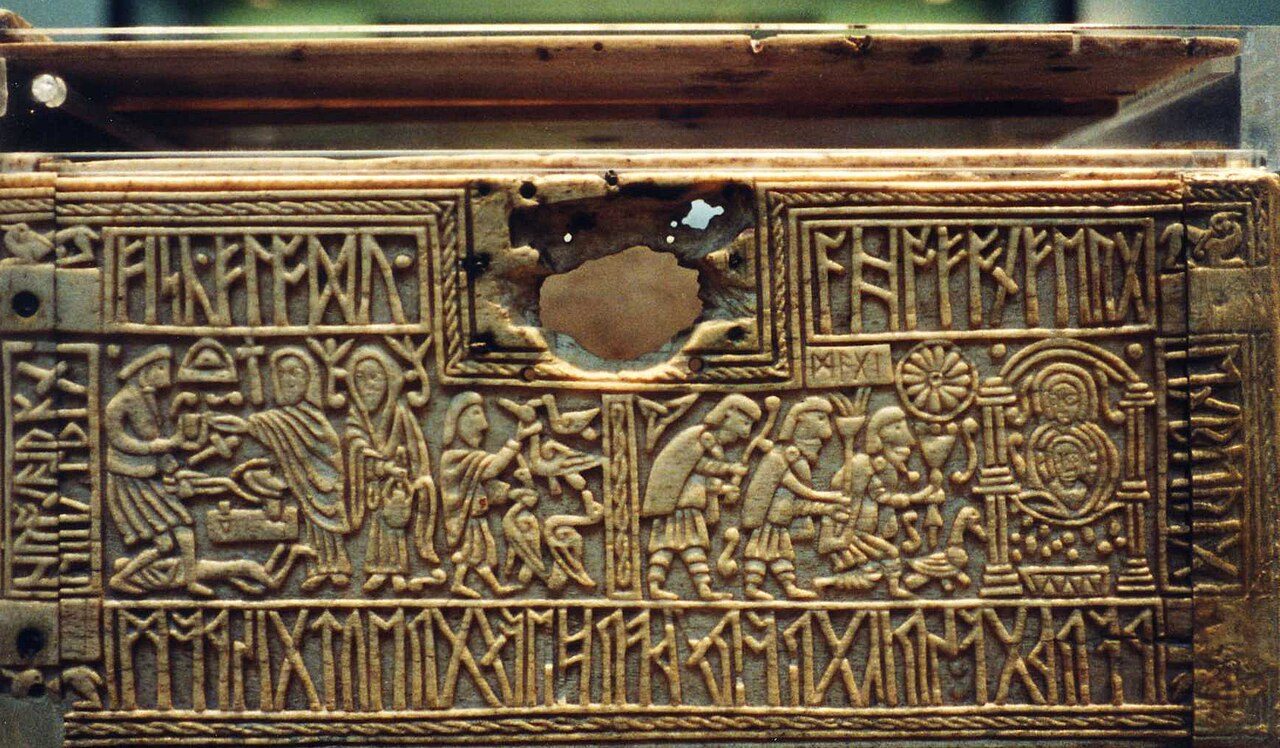
- The front text is a riddle about the box's own material: a stranded whale
- Old English and Latin, in runes and Roman capitals, on one object
- Weland the smith beside the Adoration of the Magi
- The right side writes its vowels in a cipher
The Franks Casket is a small box of whale bone, about 23 cm long, carved on every surface with scenes and inscriptions. It was made in Anglo-Saxon England, most probably in Northumbria, in the first half of the 8th century. It is the most varied object in the runic tradition of England: its texts are in Old English and Latin, in runes and Roman letters, and they run forward, backward and upside down.
How it survived
In the early 19th century the casket belonged to a family in Auzon, a village in Haute-Loire, France, who used it as a sewing box. Investigations by W. H. J. Weale suggested it had earlier belonged to the church of Saint-Julien at Brioude nearby. After its silver fittings were removed the panels fell apart. They passed through a professor at Clermont-Ferrand to a Paris dealer, from whom Augustus Wollaston Franks bought them in 1857; he gave them to the British Museum in 1867. The missing right side was found later in Auzon, sold to the Bargello Museum in Florence, and identified as part of the casket in 1890.
The front: a riddle about the box itself
The front shows two scenes side by side: on the left, the smith Weland (Old Norse Vǫlundr) in his forge, taking revenge on King Niðhad; on the right, the Adoration of the Magi, labeled mægi. The runic text around them refers to neither scene. It is a riddle on the casket's own material: "The flood cast the fish onto the mountain-cliff; the terror-king grew sad where he swam onto the shingle. Whale's bone." The alliterating lines describe a whale stranded on a beach, the source of the bone.
The other sides
The left side shows Romulus and Remus fed by the she-wolf, with an Old English caption. The back shows the capture of Jerusalem by the Roman general Titus in AD 70: one line is Old English in runes, then the text switches to Latin, first in Roman capitals (HIC FUGIANT HIERUSALIM) and then in runes (afitatores, "inhabitants"). The lid shows an archer labeled ægili, usually taken as Egil, Weland's brother in Norse legend. The right side, in Florence, has a text whose vowels are replaced by invented signs; it is the most obscure part of the casket.
Why it matters
The casket shows a learned, probably monastic, workshop that moved freely between scripts and languages and placed Germanic legend (Weland), Roman history (Titus, Romulus) and Christian scripture (the Magi) side by side. Leslie Webster and others read the scenes as a planned program about exile, kingship and salvation. For runic history it is a key early witness to the futhorc of Northumbria, including the runes ac, aesc and os, and to the use of runes for literary verse, not only names and labels. Compare the Ruthwell Cross, also Northumbrian and also carrying Old English verse in runes.
The full reading
Front (around the Weland and Magi scenes)
- fisc flodu ahof on fergenberig — "The flood lifted the fish onto the mountain-cliff;"
- warþ gasric grorn þær he on greut giswom — "the terror-king(?) grew sad where he swam onto the shingle."
- hronæs ban — "Whale's bone."
- Label over the Magi: mægi — "Magi".
Left side (Romulus and Remus)
- romwalus and reumwalus twœgen gibroþær afœddæ hiæ wylif in romæcæstri oþlæ unneg — "Romulus and Remus, two brothers; a she-wolf fed them in Rome, far from their homeland."
Back (Titus and Jerusalem)
- her fegtaþ titus end giuþeasu — "Here Titus and the Jews fight."
- HIC FUGIANT HIERUSALIM (Roman letters) afitatores (runes) — Latin: "Here the inhabitants flee from Jerusalem."
- Corner words: dom "judgment", gisl "hostage(s)".
Lid: ægili — "Egil" (the archer).
Right side: a text with ciphered vowels, beginning her hos sitæþ on hærmbergæ "here Hos sits on the harm-mound"; reading and meaning disputed.
What scholars agree and disagree on
- gasric. The word in the front riddle has no certain meaning. It is commonly explained as a poetic word for the whale, "terror-king" or similar (RuneS gives Gās(t)rīc), and is the subject of the second clause; other explanations have been offered.
- The lid. Most scholars, and the British Museum, accept Egil, brother of Weland. Karl Schneider (1959) read Ægili as Achilles; others have proposed biblical scenes (Gabriele Cocco 2009: Elisha and King Joash).
- The right side. No reading has general acceptance, partly because of the vowel cipher and two damaged runes. Page's reading begins her hos sitæþ on hærmbergæ; Thomas Bredehoft proposed a different reading of one rune. The scenes have been linked to Sigurd, to Weland, or to an otherwise unknown legend.
- Programme. The older view saw an eccentric mixture of pagan and Christian stories; the current majority view (Webster 2012) sees a deliberate Christian program in which the scenes answer each other.
- Origin. Northumbrian origin is generally accepted from the dialect of the inscriptions; a link with the monastery at Ripon has been suggested but cannot be proved.
Sources
- RuneS-Datenbank (Göttingen Academy of Sciences and Humanities), find no. 603, 'Kästchen von Auzon' (OE-F-3).
- Page, R. I. (1999), An Introduction to English Runes, 2nd ed. Woodbridge: Boydell.
- Webster, Leslie (2012), The Franks Casket. London: British Museum Press.
- Wikipedia, 'Franks Casket' (for checking).
Readings are given as facts with their source; translations on this page are our own.