

What to notice
- The oldest surviving line of Germanic alliterative verse
- A complete sentence: subject, name, object and verb
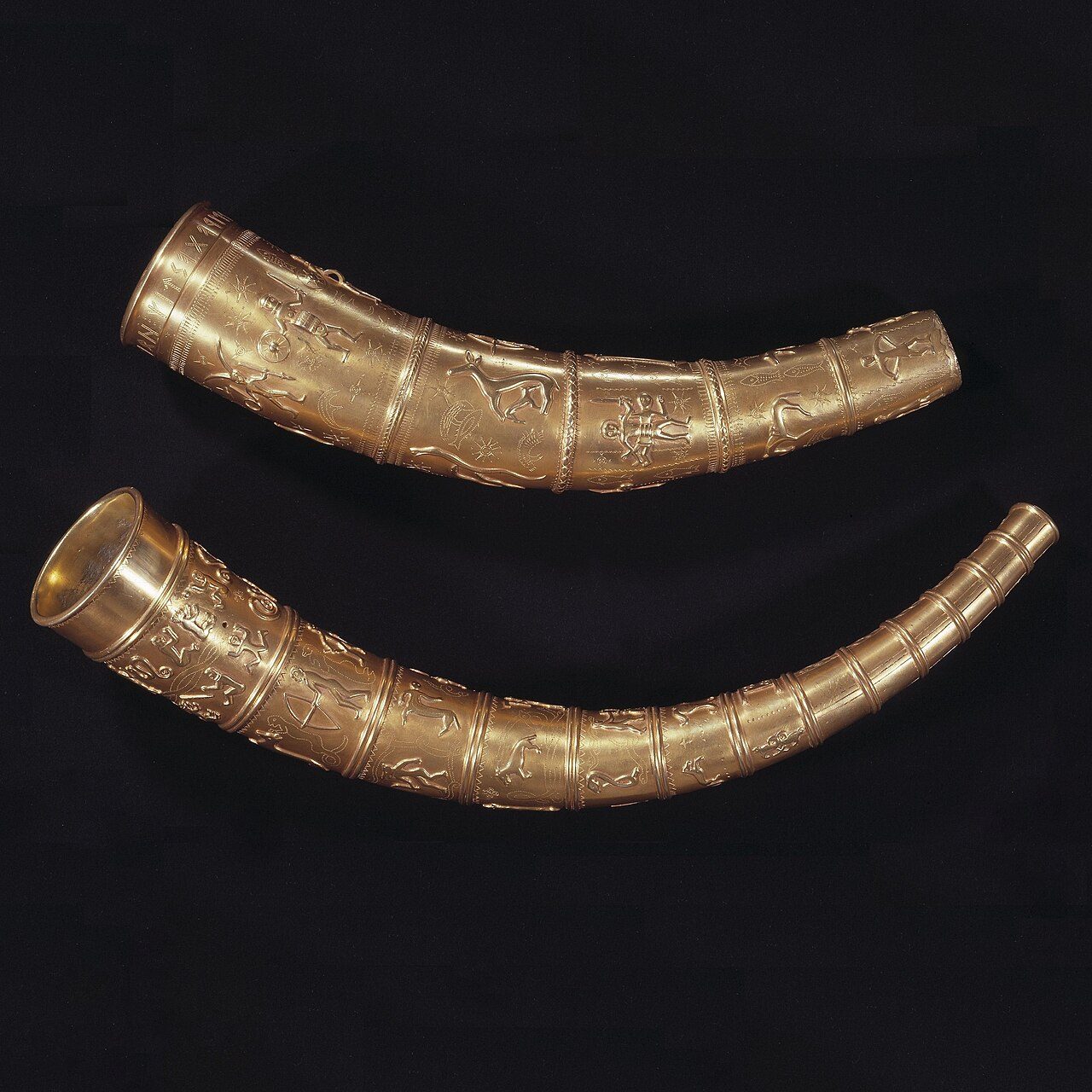
- The horns were melted down in 1802; every photograph shows a replica
- Final ᛉ writes the Proto-Norse ending -z in hlewagastiz and holtijaz
The golden horns of Gallehus were two horns of sheet gold found near the village of Gallehus, north of Møgeltønder in South Jutland, Denmark. The longer horn was found in 1639 by a young woman, Kirsten Svendsdatter, and given to King Christian IV; the shorter one was found in 1734 by a farmer, Erich Lassen, only some 15–20 meters from the first find spot. The shorter horn carried a runic inscription around its rim. Both were kept in the royal Kunstkammer in Copenhagen until 4 May 1802, when a goldsmith, Niels Heidenreich, stole them and melted them down. Every photograph of "the golden horns" today shows a replica.
The objects
Each horn was built of two layers of gold sheet: a smooth inner layer of gold alloyed with silver and an outer layer of nearly pure gold, made up of rings covered with cast and chased figures. The figures include armed men, animals, serpents and a three-headed figure. Many attempts have been made to identify them with Norse gods or myths, but they depend on 17th- and 18th-century drawings, and none is generally accepted. The horns are dated to the early 5th century, by comparison of their ornament with finds from Sösdala in Sweden and with decorated urns from the cemetery at Süderbrarup in Angeln.
The inscription
The text is known from drawings made in 1734 and shortly after; the drawing published by Richard Joachim Paulli in 1734 is considered the most reliable. It reads ek hlewagastiz holtijaz horna tawido, "I, Hlewagastiz, Holt's son, made the horn". The words are separated by dividers, and the line is complete.
This is one of the earliest runic inscriptions in the Elder Futhark to record a full sentence with a subject, an object and a verb, and it is also the oldest preserved line of Germanic alliterative verse: Ek Hlewagastiz Holtijaz / horna tawidō, with the h-sounds of Hlewagastiz, Holtijaz and horna binding the line, the same principle used in Beowulf and in the Eddic poems many centuries later.
Why it matters
For historical linguistics the line is a showcase of Proto-Norse grammar. ek is the first-person pronoun (Old Norse ek, English I); the endings -az and -iz are full, unreduced case endings (algiz writes the final z); and tawido shows a weak past tense ending in -ō. The formula "I, X, made" is common in early runic texts; compare the Tune stone (ek wiwaz ... worahto) and the Einang stone.
The loss of the horns made them a national symbol in Denmark. Adam Oehlenschläger's poem Guldhornene ("The Golden Horns"), written in 1802, turned the theft into a story about a lost golden age, and the replicas themselves have been stolen and recovered twice, in 1993 and 2007.
The full reading
ek hlewagastiz : holtijaz : horna : tawido :
- ek — I
- hlewagastiz — a man's name, Hlewagastiz
- holtijaz — "son (or descendant) of Holt", or "the one from the wood"
- horna — the horn (accusative)
- tawido — made (first person past tense of a verb "to make, prepare")
"I, Hlewagastiz, Holt's son, made the horn."
What scholars agree and disagree on
The reading of the inscription is settled: Rundata (DR 12), Krause and Jankuhn (1966, no. 43) and RuneS agree on ek hlewagastiz holtijaz horna tawido. Because the horn is lost, all study depends on the 1734 drawings, and small details of rune shape cannot be checked.
- Hlewagastiz. The first element may be the word for "shelter, lee" or the word for "fame, glory" (as in Greek kleos); the second is "guest". Both "Lee-guest" and "Fame-guest" have supporters.
- Holtijaz. Either a patronymic, "son or descendant of Holt", or a description, "the one from the wood". Most editions translate it as a patronymic.
- tawido. Usually "made", but the verb can also mean "prepared" or "finished", so Hlewagastiz may have been the goldsmith or the person who had the horn made.
- Hidden runes on the long horn. Willy Hartner (1969) argued that the figures on the uninscribed horn encode a second runic text, and linked the images to eclipses of 412 and 413. This has not been accepted by runologists.
Sources
- Samnordisk runtextdatabas (Rundata), DR 12.
- RuneS-Datenbank (Göttingen Academy of Sciences and Humanities), find no. 28, 'Goldhorn 2 von Gallehus' (KJ 43, DR 12).
- Krause, Wolfgang & Jankuhn, Herbert (1966), Die Runeninschriften im älteren Futhark, no. 43.
- Jacobsen, Lis & Moltke, Erik (1941–42), Danmarks Runeindskrifter, no. 12.
- Hartner, Willy (1969), Die Goldhörner von Gallehus. Wiesbaden.
- Wikipedia, 'Golden Horns of Gallehus' (for checking).
Readings are given as facts with their source; translations on this page are our own.