

What to notice
- A curse on whoever breaks the monument
- The a-rune has the shape ᚼ, later the Younger Futhark h-rune
- Part of the Blekinge group (with Stentoften, Istaby, Gummarp) that shows the rune row changing
- One of the tallest runestones, about 4 m
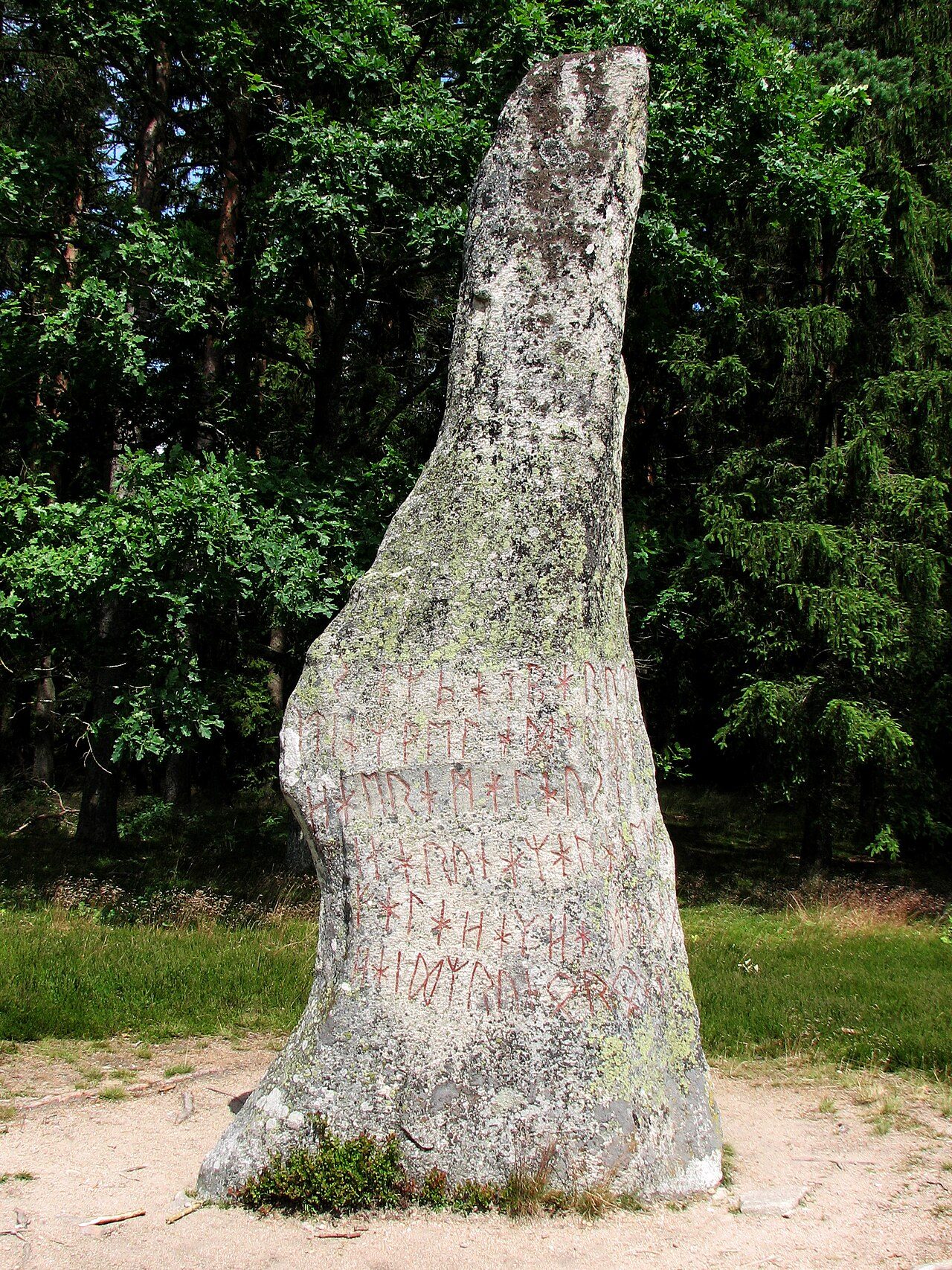
The Björketorp runestone stands in woodland about 7 km east of Ronneby in Blekinge, southern Sweden. About 4 m high, it is one of the tallest runestones known. Together with two tall uninscribed stones it forms a triangle-shaped monument beside a grave field of the later Iron Age. Blekinge was Danish territory until 1658, which is why the stone has a Danish signum, DR 360. It was first drawn around 1627 by Jon Skonvig for the Danish antiquarian Ole Worm.
A curse
The inscription is on two faces. The short text on side B, uþᴀrᴀbᴀsbᴀ, is read as uþarba spā, "prophecy of ruin" or "I foretell ruin". Side A is longer and is a threat against anyone who damages the monument: the carver says he has hidden powerful runes here, and that whoever breaks "this" will be restless through argiu, perversity or wickedness, and meet a treacherous death. It is one of the few runic curse formulas from before the Viking Age, and it says nothing about who raised the stone or for whom.
Transitional runes
Björketorp belongs to a small group of 6th–7th-century inscriptions from Blekinge, with Stentoften, Istaby and Gummarp (the last lost in the Copenhagen fire of 1728). Their runes stand between the 24-rune Elder Futhark and the 16-rune Younger Futhark of the Viking Age. The most visible example is the a-rune: Björketorp writes the sound a with a sign shaped like the later hagall rune ᚼ, the descendant of Elder jera. Runologists transliterate it with a small capital ᴀ to keep it apart from ordinary a (ansuz). The k-rune also has an intermediate Y-like form. These stones are central evidence for how and when the rune row was reduced.
The Stentoften stone, a few tens of kilometers away, carries almost the same curse in different wording, so the formula was shared within one tradition. Stentoften, Istaby and Gummarp name men of one family, with names like Haþuwolafz and Hariwolafz; Björketorp names no one.
Language
The language is late Proto-Norse, after the syncope that shortened many words (compare runo here with the Einang stone) but before the Viking Age. ginnarunaz, "mighty runes", contains the element ginn-, "great, divine" or "deceptive", known from Old Norse Ginnungagap.
What was it for?
Excavations in 1914 found no burial under or beside the stone. Scholars have suggested a cenotaph for someone buried elsewhere, a sanctuary, or a boundary marker; none is proved. The curse protects the monument, whatever it marked.
The full reading
Side A (three lines)
- hᴀidz runo ronu — "bright runes' row" (or "secret of the runes"); disputed
- falᴀhak hᴀiderᴀ g inᴀrunaz — "I hid here mighty runes"
- ᴀrᴀgeu hᴀerᴀmᴀlᴀusz — "through perversity (or wickedness), without rest"
- utiᴀz welᴀdᴀude — "abroad(?), (by) a treacherous death"
- sᴀz þᴀt bᴀrutz — "(is) he who breaks this"
Side B
- uþᴀrᴀbᴀsbᴀ — uþarba spā, "prophecy of ruin" or "I foretell ruin"
What scholars agree and disagree on
- The opening, hᴀidz runo ronu. Rundata's translation takes haidz as "master of the runes(?)"; RuneS and others take haidz rūnō runu as "the row of bright runes" or "the secret of the runes". The words are clear; the grammar is not.
- utiᴀz. Read as "outside, abroad" ("he will die far from home") or as part of a description of the doom; Jóhanna Barðdal (1998) discussed utiaz weladaude in detail.
- Date. Most scholars place the inscription in the 7th century on runological grounds; there is no archaeological date because no finds were made at the stone.
- Function. Grave, cenotaph, sanctuary or border marker remain open. Michael Schulte (2008) compared the more formal style of Björketorp with the more archaic Stentoften text and argued for stylistic variation within a single tradition.
- Magic? The curse is real, but calling it "rune magic" in a modern sense goes beyond the text; it is a formula of protection and threat, like curses on later Viking Age stones (for example DR 81 at Skern).
Sources
- Samnordisk runtextdatabas (Rundata), DR 360.
- RuneS-Datenbank (Göttingen Academy of Sciences and Humanities), find no. 93, 'Stein von Björketorp' (Bl 6, DR 360, KJ 97).
- Jacobsen, Lis & Moltke, Erik (1941–42), Danmarks Runeindskrifter, no. 360.
- Krause, Wolfgang & Jankuhn, Herbert (1966), Die Runeninschriften im älteren Futhark, no. 97.
- Barðdal, Jóhanna (1998), 'Björketorpstenens utiar weladaude', Sydsvenska ortnamnssällskapets årsskrift, 7–16.
- Schulte, Michael (2008), 'Stylistic variation in runic inscriptions?', Arkiv för nordisk filologi 123, 5–22.
- Wikipedia, 'Björketorp Runestone' and Swedish Wikipedia, 'Björketorpsstenen' (for checking).
Readings are given as facts with their source; translations on this page are our own.