
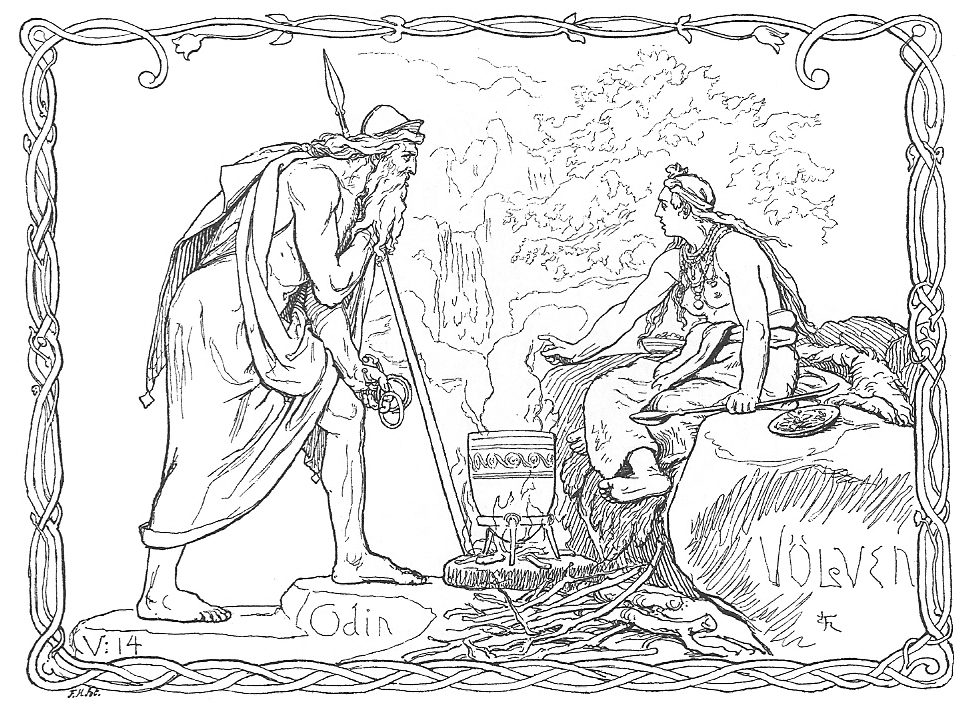

The problem of the sources
Almost everything written about seiðr was written in Iceland in the 13th and 14th centuries, by Christians, two or three hundred years after Iceland's conversion in about 1000. The sagas describe a pagan past their authors had not seen, sometimes with evident antiquarian interest, sometimes as a source of horror or comedy. Eddic poems may be older, but their dates are uncertain. Archaeology gives independent evidence, but objects do not come labelled with Old Norse words. Every statement about "what seiðr was" is a reconstruction from these three kinds of evidence, and scholars disagree about how far the saga scenes can be trusted.
The words
- seiðr: the practice; the verb is síða, "to perform seiðr". The origin of the word is disputed. One proposal links it to words for a cord or girdle (Old English sāda, "cord, halter"); Eldar Heide (2006) developed this into a theory of seiðr as spinning out the mind.
- völva: a seeress, probably "staff-bearer", from völr, staff. Also spákona, "prophecy woman", and seiðkona. A male practitioner is a seiðmaðr.
- galdr: an incantation, a spell sung or spoken; related to gala, "to crow, to chant". Galdr and runes are often named together; seiðr is a separate thing.
- varðlokkur: the songs sung at a seiðr session in Eiríks saga rauða. The meaning of the word is uncertain.
The seeress in Greenland: Eiríks saga rauða, chapter 4
The fullest description of a seiðr session in Old Norse is in the saga of Eiríkr the Red, written in Iceland in the 13th century about events around the year 1000. A famine has struck the Norse settlement in Greenland, and the farmer Þorkell of Herjólfsnes invites the prophetess Þorbjörg, called lítilvölva, "little seeress", the last of nine sisters, all of them seeresses. The saga describes her clothes as if from an inventory:
Hon hafði yfir sér tuglamöttul blán, ok var settr steinum allt í skaut ofan. Hon hafði á hálsi sér glertölur, lambskinnskofra svartan á höfði ok við innan kattarskinn hvít. Ok hon hafði staf í hendi, ok var á knappr. She wore a blue cloak with straps, set with stones all down to the hem. Around her neck she had glass beads, and on her head a hood of black lambskin lined with white catskin. And she had a staff in her hand, with a knob on it.Eiríks saga rauða, ch. 4
She carries a large pouch for the charms she needs "for her knowledge", wears calfskin shoes and catskin gloves, and is served a porridge of goat's milk and a dish made from the hearts of every kind of animal on the farm. A high seat with a cushion stuffed with hen's feathers has been made ready for her. The next day she asks for women who know the songs called varðlokkur. Only one does: Guðríðr, a young Christian woman, who learned them from her foster-mother in Iceland and refuses at first. Pressed by Þorkell, she sings, the women form a ring around the platform (hjallr) where Þorbjörg sits, and the seeress says that many spirits have come because the song was so beautifully sung. She foretells the end of the famine and a great future for Guðríðr, and then answers each person's questions.
The scene is often used as a description of real practice, and its detail is remarkable. But the saga also has reasons of its own to tell it: Guðríðr was the ancestor of Icelandic bishops, and the prophecy of her descendants is the point of the episode for its 13th-century readers. Scholars weigh how much is memory and how much is literary construction; most accept that the author drew on some knowledge of older practice.
Óðinn, Freyja and ergi: Ynglinga saga
Snorri Sturluson's Ynglinga saga, the first part of Heimskringla (around 1230), treats the gods as human rulers. He says Freyja, of the Vanir, first taught seiðr to the Æsir (ch. 4), and that Óðinn practised it himself (ch. 7):
Óðinn kunni þá íþrótt, er mestr máttr fylgði, ok framdi sjálfr, er seiðr heitir. En af því mátti hann vita örlög manna ok úorðna hluti, svá ok at gera mönnum bana eða úhamingju eða vanheilindi, svá ok at taka frá mönnum vit eða afl ok gefa öðrum. En þessi fjölkyngi, er framit er, fylgir svá mikil ergi, at eigi þótti karlmönnum skamlaust við at fara, ok var gyðjunum kend sú íþrótt. Óðinn knew the art that carries the greatest power, and practised it himself; it is called seiðr. By it he could know the fates of men and things not yet come to pass, and also bring death, misfortune or sickness on people, and take wit or strength from some and give it to others. But this sorcery, when it is performed, brings with it so much ergi that men thought it shameful to practise, and the art was taught to the priestesses.Ynglinga saga, ch. 7
Ergi is unmanliness, an insult with a sexual sense, and the link between seiðr and shame for men is consistent in the sources. In the Eddic poem Lokasenna (stanza 24), Loki taunts Óðinn: "they say you practised seiðr on Samsey and beat on a vétt like seeresses; in a wizard's likeness you went among men, and I thought that the mark of an argr one". What a vétt was (a drum, a lid, a box) is uncertain, and much has been built on the guess that it was a drum.
Seiðr that kills: Laxdæla saga
Most saga seiðr is hostile. In Laxdæla saga, a Hebridean family, Kotkell and his wife Gríma and their sons, are outsiders "skilled in sorcery". Charged at law by Þórðr Ingunnarson, Kotkell has a great seiðr platform (seiðhjallr) built; the family climbs onto it and chants spells, a storm rises, and Þórðr drowns at sea (ch. 35). Later, at night, they perform seiðr outside the house of Hrútr Herjólfsson. The household hears a beautiful chanting; Hrútr alone knows what it is and tells everyone to stay awake and not look out. All fall asleep, and Hrútr's twelve-year-old son Kári, at whom the spell is aimed, gets up, looks out "into the seiðr", and falls dead (ch. 37). In Ynglinga saga the sorceress Huld is twice paid to work seiðr against kings of the Swedish dynasty.
The archaeology: staffs in women's graves
About forty Viking-age graves in Scandinavia contain iron staffs, mostly with women, often with other unusual objects. Neil Price (2002) argued that many are the graves of seeresses like Þorbjörg, and that the staffs are the völr from which the völva took her name; Leszek Gardeła (2016) has since catalogued and classified them in detail. Two often cited: a woman's grave at Fyrkat in Denmark (grave 4), with a staff, a pouch containing henbane seeds, and other unusual items; and a grave at Köpingsvik on Öland, with a staff. Not every iron rod in a grave need be a magic staff (some have been read as roasting spits or measuring rods), and the identification of any one grave as a seeress's is an interpretation, but the pattern is real and fits the saga descriptions in striking ways.
Seiðr and shamanism
Dag Strömbäck's Sejd (1935) compared seiðr with the practices of the Sámi noaidi and Siberian shamans: trance, spirit helpers, songs, a raised seat. The comparison is old and still debated. Some scholars (Price; Tolley, Shamanism in Norse Myth and Magic, 2009) see real contact between Norse and Sámi practice, for which the sagas themselves give evidence, since several describe Sámi (finnar) as sorcerers. Others warn that "shamanism" is a modern category assembled from many cultures, and that reading it back into 13th-century Icelandic prose can make the texts say more than they do. The sources do agree on a few things: seiðr was mostly women's work, it involved songs and a raised platform, it could reveal the future and do harm, and for a man it was shameful.
Modern seiðr
Since the 1980s, groups within modern Heathenry and neo-paganism have revived practices they call seiðr or oracular seiðr, reconstructed largely from the Greenland scene in Eiríks saga. They are modern religious practices with their own histories. This site describes the medieval evidence and does not offer or endorse any practice.