

What to notice
- witandahlaiban, 'bread-ward', built like Old English hlāford, the source of 'lord'
- Lines run in alternating directions (boustrophedon)
- Three daughters and an inheritance: early evidence for women as heirs
- after, 'in memory of', the memorial formula of later runestones
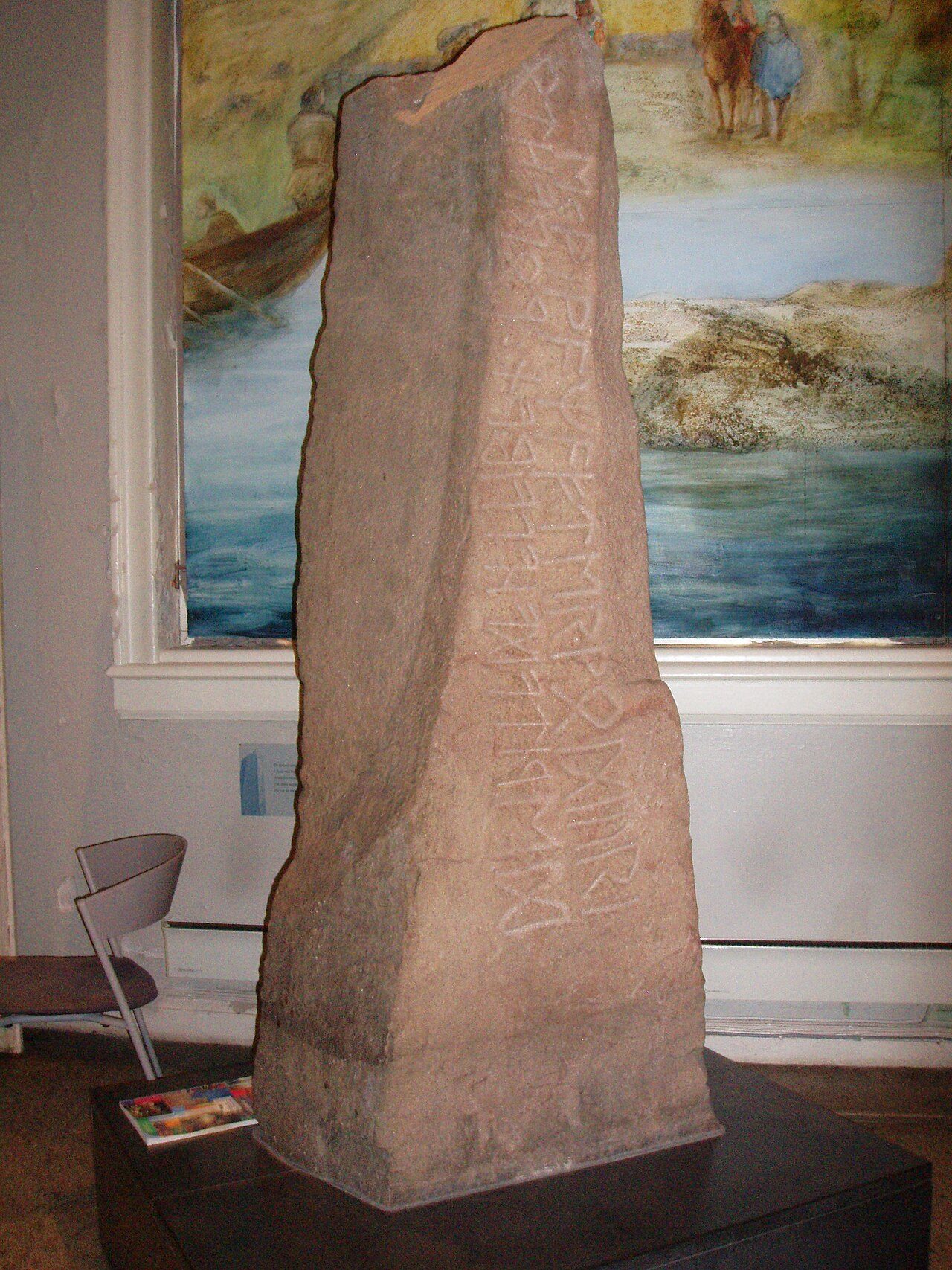
The Tune stone is a slab of red granite about 1.9 m high, carrying one of the longest and most discussed inscriptions in Proto-Norse. It was found in 1627 built into the churchyard wall of Tune church in Østfold, southeastern Norway, and is now in the Museum of Cultural History in Oslo. The church dates from the 12th century; the stone may originally have stood on a large burial mound nearby, and if so it belongs before about 400, perhaps in the 3rd century.
The layout
The inscription runs in five lines on two faces. Side A has two lines, side B three. Several lines change direction, running right to left and then left to right (boustrophedon), and individual runes face whichever way their line runs. The top of the stone is damaged, so the end of side A and the start of side B are partly lost.
Side A: the carver and the dead man
Side A is reasonably clear: ek wiwaz after woduride witadahalaiban worahto r[unoz], "I, Wiwaz, made [the runes] in memory of Woduridaz, the bread-ward." The phrase witandahlaiban is literally "the one who watches over the bread", a title for a lord or head of household, built in the same way as Old English hlāford ("loaf-ward"), the ancestor of English lord. The formula "I, X, made" places the carver at the center, as on the Gallehus horn and the Einang stone, but here it is combined with a memorial: after, "in memory of", is the same word that introduces memorials on Viking Age runestones centuries later (Old Norse eptir).
Side B: daughters and inheritance
Side B mentions þrijoz dohtriz, "three daughters", the verb dalidun (they "prepared" or "divided") and the words arbija and arbijano, related to Old Norse arfr, "inheritance" (English heir is from a different, Latin, source; German Erbe is the cognate). The word arbija can mean "inheritance" or, by extension, the funeral feast at which an inheritance was taken over. The three daughters therefore either prepared the stone, shared the inheritance, or held the funeral ale.
Why it matters
Tune is the oldest written evidence from Norway that touches on burial, inheritance and the role of daughters as heirs. Linguistically it shows full Proto-Norse endings (-az, -iz, -oz), the algiz rune for z, and words with direct descendants in Old Norse. It is also among the earliest runestones raised in memory of a named person, the form that dominates later runic tradition on stones such as the Jelling stones.
The full reading
Side A
- ek wiwaz after woduri|de witadahalaiban : worahto : r[unoz] — "I, Wiwaz, in memory of Woduridaz, the bread-ward (lord), made the runes."
Side B (beginning lost)
- [me]z(?) woduride : staina : — "for (me?) Woduridaz ... the stone"
- þrijoz dohtriz dalidun — "three daughters prepared (or shared)"
- arbija arjostez(?) arbijano — "the inheritance (or the funeral feast), the most noble(?) of the heirs"
The B side is the disputed part; see debates.
What scholars agree and disagree on
Side A is broadly agreed; side B has no consensus reading.
- Early readings. Sophus Bugge (1903) and Carl Marstrander (1930) gave the first systematic interpretations.
- Grønvik (1981). Ottar Grønvik's monograph Runene på Tunesteinen gave the first interpretation widely accepted as convincing for the whole text, with three daughters preparing the funeral ale (arbija as the inheritance feast). Rundata's normalization follows a reading close to Grønvik's.
- Spurkland (2001). Terje Spurkland reads side B as "I left Woduridaz the stone; three daughters prepared the burial ale, the most god-born(?) of the heirs".
- Open points. The lost runes at the start of B ([me]z?), the word read arjostez ("most noble") with a damaged first part, and whether dalidun means "prepared" or "divided". RuneS records both "shared the inheritance" and "prepared the funeral feast".
- Date. Estimates run from c. 200 to c. 450; the archaeological argument for the 3rd century depends on the assumption that the stone first stood on a nearby rich grave.
Sources
- Samnordisk runtextdatabas (Rundata), N KJ72.
- RuneS-Datenbank (Göttingen Academy of Sciences and Humanities), find no. 32, 'Stein von Tune' (N KJ72, NIæR 1).
- Krause, Wolfgang & Jankuhn, Herbert (1966), Die Runeninschriften im älteren Futhark, no. 72.
- Grønvik, Ottar (1981), Runene på Tunesteinen. Oslo: Universitetsforlaget.
- Spurkland, Terje (2001/2005), I begynnelsen var fuþark / Norwegian Runes and Runic Inscriptions. Woodbridge: Boydell.
- Wikipedia, 'Tune stone' (for checking).
Readings are given as facts with their source; translations on this page are our own.