

What to notice
- Language closer to 19th-century Swedish than to the Swedish of 1362
- opdagelsefärd, 'journey of discovery', a word not attested before the 16th century
- Rune forms for ä and ö that match 1880s Swedish alphabets
- Pentadic numerals instead of numbers in words
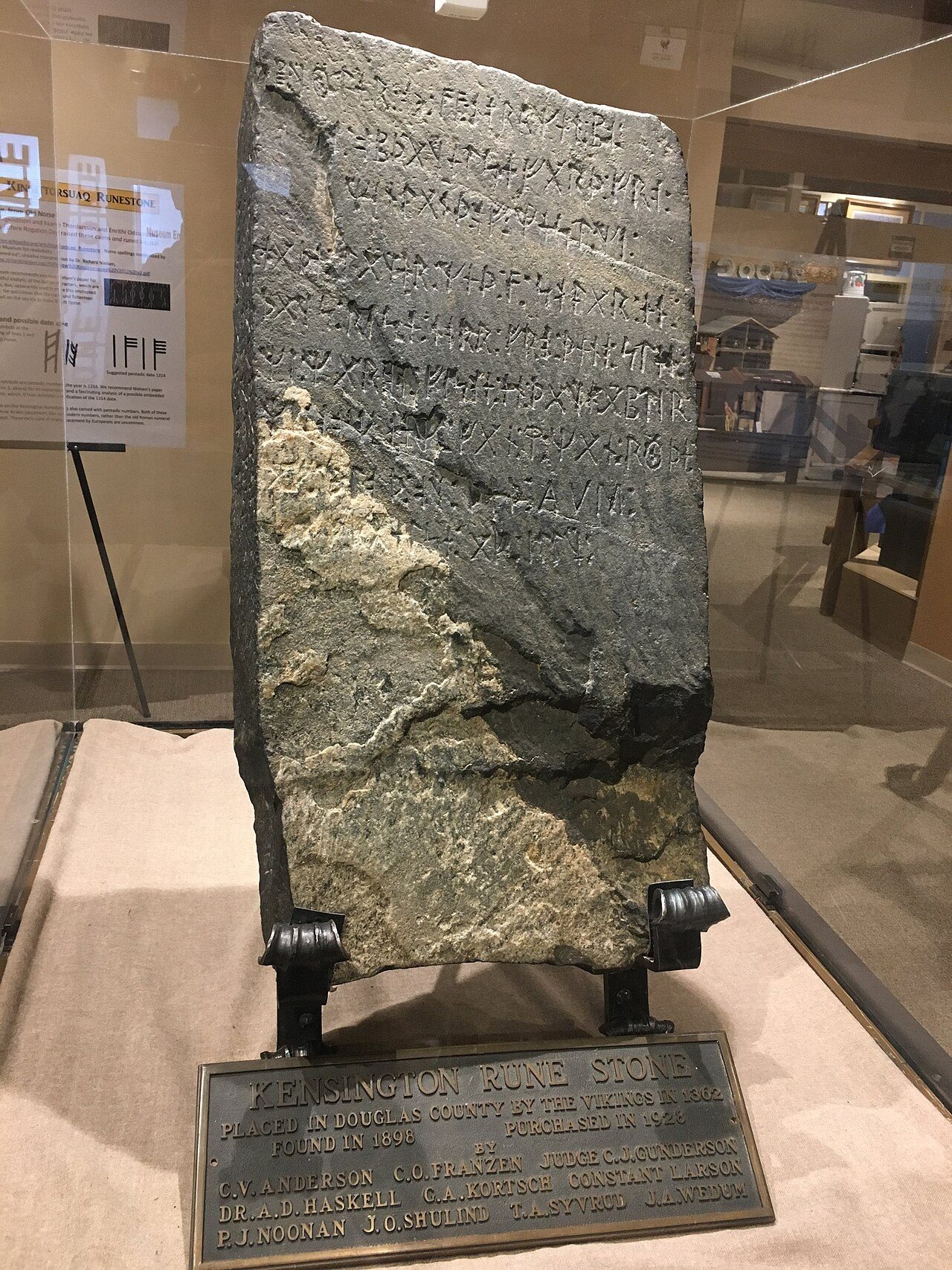
The Kensington Runestone is a slab of greywacke about 76 cm high, covered on one face and one edge with runes. Olof Ohman, a Swedish immigrant farmer, said he found it in 1898 while clearing trees on his land in Solem Township, Douglas County, Minnesota, lying face down in the roots of a small poplar. Its text describes an expedition of Götalanders and Norwegians from Vinland, ten men found "red with blood and dead", and the date 1362. The stone is now in the Runestone Museum in Alexandria, Minnesota.
The scholarly verdict
Since the first examinations, runologists and Scandinavian linguists have judged the inscription to be a 19th-century creation. Olaus J. Breda of the University of Minnesota sent copies of the text to colleagues in Scandinavia, including Sophus Bugge, Gustav Storm, Oluf Rygh, Magnus Olsen and Adolf Noreen, who rejected it as recent. George T. Flom's study of 1910 reached the same conclusion on linguistic grounds. Later specialists, among them Sven B. F. Jansson, Erik Moltke and Erik Wahlgren in the mid-20th century and Magnus Källström and Henrik Williams more recently, have agreed. The evidence falls under three heads.
The language
The text reads like 19th-century Swedish with Norwegian and dialect features, not like the Old Swedish of the 14th century. It lacks the case endings and plural verb forms that 14th-century Swedish still used (vi var, vi kom instead of plural forms such as varum, komum). Its key word opdagelsefärd, "journey of discovery", is built on opdage, a word borrowed from Low German that is not attested in Scandinavia before the 16th century, and the Norwegian historian Gustav Storm had used the modern phrase in articles about Norse exploration published shortly before 1898.
The runes
At least seven of the rune forms, including those transliterated a, d, v, j, ä and ö, are not known from any medieval inscription. Letters for ä and ö answer to the modern Swedish alphabet. The numbers are written with pentadic numerals, known from later Scandinavian calendars, not from medieval runestones, where numbers are spelled out.
The 19th-century parallels
In 2004 papers written in 1883 and 1885 by Edward Larsson, a young journeyman tailor, came to light in Sweden. They record runic alphabets whose special forms closely match many Kensington runes; the Larsson brothers came from Dala-Floda in Dalarna, the province where the folk script known as Dalecarlian runes (dalrunor) was used from the 16th into the early 20th century. In 2019 short inscriptions with similar runes, dated 1870 and 1877, were found at Kölsjön in Hälsingland, not far from Ohman's home parish of Forsa, and the archaeologist Mats G. Larsson has documented connections between Ohman and people there. Magnus Källström of the Swedish National Heritage Board has argued from a runic stave from Haverö that the source tradition should be sought in northern central Sweden. These finds show that runic alphabets of the Kensington type circulated in rural Sweden in the 1870s and 1880s.
Why it matters
The Kensington stone is a case study in how runic evidence is tested: language, rune forms and context all point the same way. It also belongs to the history of Scandinavian America, where pride in Norse exploration ran high in the 1890s.
The full reading
As usually transcribed (front, nine lines; edge, three lines), with my translation:
- 8 göter ok 22 norrmen po ...o opdagelsefärd fro vinland of vest — "8 Götalanders and 22 Norwegians on a journey of discovery from Vinland westward."
- vi hade läger ved 2 skjär en dags rise norr fro deno sten — "We had a camp by two skerries, one day's journey north of this stone."
- vi var ok fiske en dagh äptir vi kom hem fan 10 man röde af blod og ded — "We were out fishing one day. After we came home we found 10 men red with blood and dead."
- AVM frälse äf illü — "AVM (Ave Virgo Maria), save from evil."
- Edge: här 10 mans ve havet at se äptir vore skip 14 dagh rise from deno öh ahr 1362 — "[We] have 10 men by the sea to look after our ships, 14 days' journey from this island. Year 1362."
What scholars agree and disagree on
- Who made it? Ohman always denied carving it. Theodore Blegen (1968) and others suspected Ohman with help from neighbors; a 1967 recorded interview (published 1976) in which Frank Walter Gran said his father John had heard Ohman confess is second-hand. Staffan Fridell and Mats G. Larsson (2016) proposed that the text's dialect points to Härjedalen and Dalarna and named Ohman's associate Anders Andersson as a possible author. The maker is not known for certain.
- Supporters of authenticity. Hjalmar Holand promoted the stone for some forty years; it was shown at the Smithsonian in 1949. Robert A. Hall (1982, 1994), a professor of Italian, argued that its linguistic oddities could be dialect; runologists including James Knirk and R. I. Page pointed out errors in his rune readings.
- Nielsen and Wolter. In the 2000s the engineer Richard Nielsen argued that the unusual runes and spellings have medieval parallels, and the geologist Scott Wolter argued from weathering of the stone's surface and minerals that the carving is centuries old; they published The Kensington Rune Stone: Compelling New Evidence (2006). Runologists reject these claims: the proposed medieval parallels do not match the specific forms, weathering rates on a buried stone of unknown history cannot be calibrated to give a date, and the language and the 19th-century Swedish runic alphabets remain unexplained by a 1362 origin.
- Dalecarlian runes. Some supporters have argued that the Kensington runes descend from medieval runes through the Dalecarlian tradition. Källström has noted that almost all the typical Dalecarlian forms are missing from the Kensington alphabet; the closest matches are the Larsson and Kölsjön alphabets of the 1870s–80s.
Sources
- Flom, George T. (1910), 'The Kensington Rune-Stone: A modern inscription from Douglas County, Minnesota', Publications of the Illinois State Historical Library 15, 3–44.
- Wahlgren, Erik (1958), The Kensington Stone: A Mystery Solved. Madison: University of Wisconsin Press.
- Källström, Magnus, article on the Kensington runes and the Haverö stave, Riksantikvarieämbetet (raa.se), accessed 2026.
- Fridell, Staffan & Larsson, Mats G. (2016), article on the Kensington inscription's dialect, Saga och Sed 2016.
- Nielsen, Richard & Wolter, Scott F. (2006), The Kensington Rune Stone: Compelling New Evidence. Lake Superior Agate Publishing.
- Wikipedia, 'Kensington Runestone' (for checking).
Readings are given as facts with their source; translations on this page are our own.