

What to notice
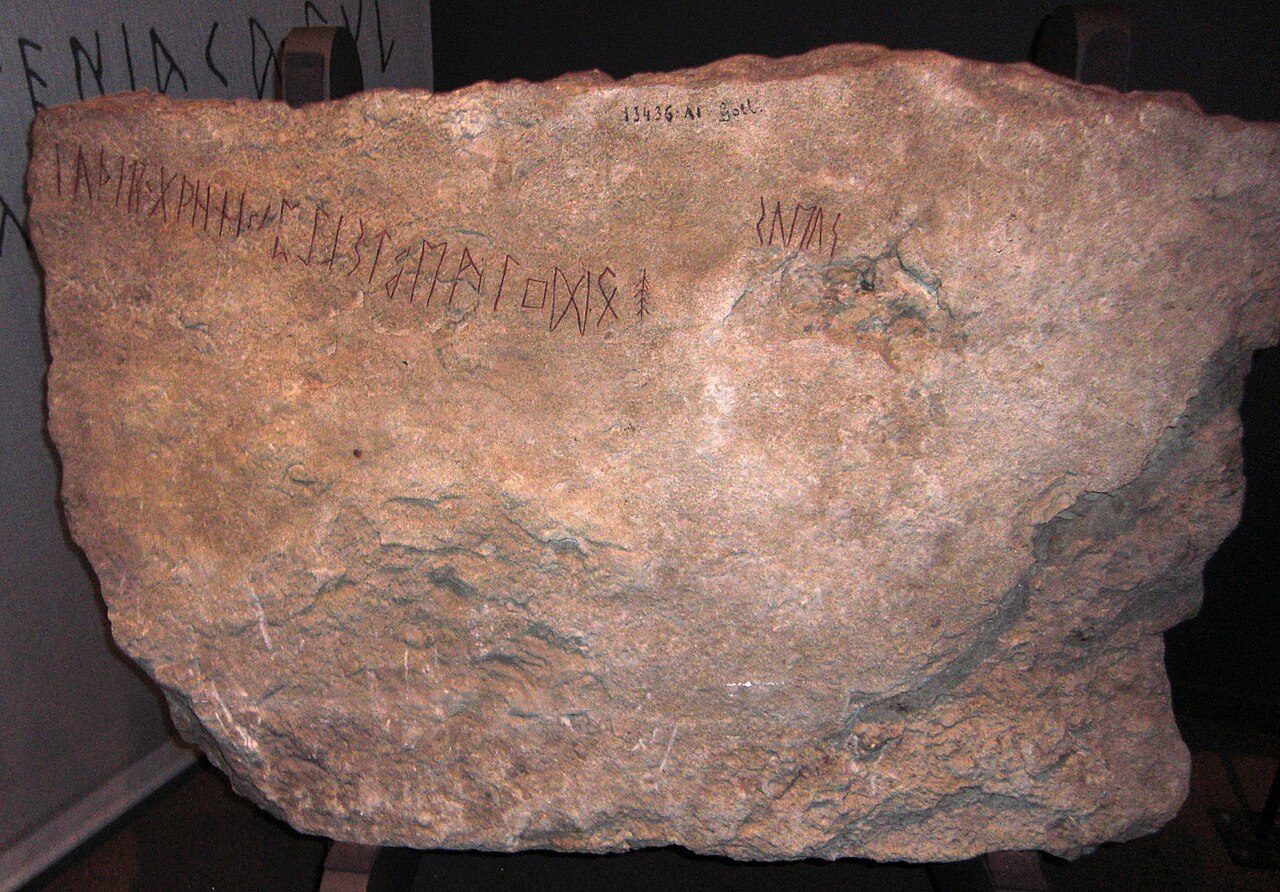
- The oldest complete row of all 24 Elder Futhark runes
- The order differs from the textbook one: p comes before ï
- Several runes are mirrored or upside down, normal for this early date
- A fir-tree sign after the row, and the palindrome sueus nearby
The Kylver stone is a flat slab of limestone found in 1903 during the excavation of a grave field on the farm Kylver in Stånga parish, on the Baltic island of Gotland. It had been used as part of a grave, with the inscribed side facing inward, so the runes could not be seen from above. The grave is dated to around AD 400, which gives the inscription a latest date. Today the stone is displayed at the Swedish History Museum in Stockholm.
The oldest complete rune row
The stone's importance lies in its content. It carries the full sequence of the 24 runes of the Elder Futhark, in order, cut in one line. It is the oldest known complete listing of the rune row, the "futhark" named after its first six letters. Before Kylver, scholars knew the order of the older runes only from much later evidence and from partial rows on objects such as the Vadstena bracteate.
The Kylver order is almost, but not quite, the order now printed in handbooks. One pair is swapped: pertho comes before eihwaz, giving ...jpïz... instead of ...jïpz.... The row ends ...ŋdo, with dagaz before othala, the order most handbooks use; some other early rows end the other way round, which suggests the last two runes were not fixed in a single order. Several individual runes are also unusual: ansuz, sowilo and berkanan face the "wrong" way, algiz (the z-rune) is upside down, and the first rune fehu and wunjo are only partly cut. Such variation is normal in the earliest inscriptions, where rune direction was not yet standardized.
The tree sign and sueus
After the last rune stands a sign like a fir tree: a vertical stave with many short branches on each side. It is not one of the 24 runes. A short distance away is a second, separate text, sueus, which reads the same backwards and forwards.
What the stone was for
Because the runes face into a grave, it has been suggested that the futhark was meant to protect the grave or keep the dead in it. There is nothing in the inscription itself to show that, and reused stones with runes are common, so the slab may have been inscribed before it was ever part of a grave. Another view is that it was a teaching or practice text: a carver writing out the alphabet. The stone does not let us choose between these with certainty.
Whatever its purpose, Kylver shows that by around 400 the rune row existed as a fixed sequence that people could reproduce from memory, much as the Latin alphabet was learned in order. The same idea lies behind the complete Anglo-Saxon row on the Seax of Beagnoth, five centuries later.
The full reading
§A (f)uþarkgwhnijpïzstbemlŋdo — the rune row, followed by a sign like a fir tree.
§B su(e)us — a palindrome, reading the same in both directions; its meaning is unknown.
What scholars agree and disagree on
- Order of the row. The Kylver order (with p before ï) differs from the "standard" order reconstructed from other sources, and early rows also disagree on whether d or o comes last. Most runologists see parts of the row as not yet fixed around 400, rather than treating Kylver as a mistake.
- The tree sign. It has been read as a stack of tiwaz runes (and so an invocation of the god Týr), or as a combination of t- and a-runes; others regard it as a decorative end mark. None of these readings can be proved, and Rundata leaves the sign unread.
- sueus. No accepted explanation exists. Carl Marstrander suggested a magical spelling of a word for "horse" written outward from the middle; critics have called this linguistically impossible for the period. A link with the people called Suiones has also been proposed. The word remains unexplained.
- Purpose. Grave magic versus practice or display text is an open question; the archaeological context (a reused slab facing inward) is compatible with both.
Sources
- Samnordisk runtextdatabas (Rundata), G 88.
- RuneS-Datenbank (Göttingen Academy of Sciences and Humanities), find no. 266, 'Stein von Kylver' (G 88, KJ 1).
- Krause, Wolfgang & Jankuhn, Herbert (1966), Die Runeninschriften im älteren Futhark, no. 1.
- Wikipedia, 'Kylver Stone' and Swedish Wikipedia, 'Kylverstenen' (for checking).
Readings are given as facts with their source; translations on this page are our own.