

What to notice
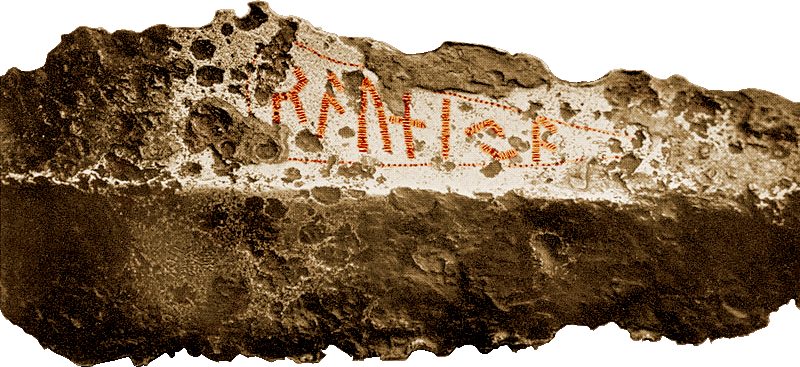
- The spear has a name: raunijaz, 'tester'
- The final ᛉ writes the Proto-Norse ending -z, later Old Norse -R
- Runes punched in a zigzag technique, partly lost to corrosion
The Øvre Stabu spearhead is an iron spearhead about 28 cm long, found in 1890 in a grave on the farm Øvre Stabu in Østre Toten, in the inland county of Innlandet, Norway. Along the blade runs a short inscription in the Elder Futhark: raunija(z). It is one of the oldest runic inscriptions known from anywhere, and one of the oldest from Norway.
Object and date
The spearhead is of a type archaeologists call Vennolum, after a Norwegian find site; about 300 spearheads of this type are known. It came from one of two graves on the farm, together with other grave goods. The type is dated to the early 3rd century, and the RuneS research database gives c. 210–240 for the object; older handbooks place it in the second half of the 2nd century. Either way it is contemporary with the earliest Danish bog finds such as the Vimose comb.
The runes were made with a zigzag punching technique rather than cut in single lines, and corrosion has eaten away part of the last rune. The reading of the first seven runes is secure.
The text
The word raunijaz is a masculine noun formed on the verb that became Old Norse reyna, "to test, try". It means "tester" or "prober", and it is understood as the name of the weapon itself. In Norse literature famous swords have names, and this inscription shows the custom of naming weapons is far older than the sagas. The runes are raido, ansuz, uruz, naudiz, isaz, jera, ansuz and algiz, the last standing for the sound z that later became Old Norse R and then r.
A group of named spears
Raunijaz has close parallels on the continent. A spearhead from Kovel (Ukraine) carries tilarids, often explained as "goal-rider" or "attacker", and one from Dahmsdorf-Müncheberg (Germany) carries ranja, "router, one who makes run". All are short names describing what a spear does. Together they show that runic writing in its first centuries was used for brief, practical labels on prestige objects, not for long texts.
Why it matters
The spearhead is evidence that runes were known in inland Norway by the early 3rd century, far from the Danish centers where most of the earliest finds come from. Its grammatical ending -z, preserved here, is a Proto-Norse feature lost in the Viking Age. Compare the Tune stone and the Einang stone for later Proto-Norse from Norway.
The full reading
raunija(z) — Raunijaz, "tester, prober": the name given to the spear.
What scholars agree and disagree on
The reading raunijaz is accepted in the standard editions (Krause and Jankuhn 1966, no. 31; Looijenga 2003) and in Rundata and RuneS, with the final z marked as damaged.
- Date. Estimates range from the second half of the 2nd century to c. 210–240. The difference reflects different chronologies for the Vennolum spear type rather than any doubt about the runes.
- Meaning. "Tester" as the name of the spear is the standard interpretation. Since the word is a name, it is impossible to prove whether it named the weapon or its owner, but the parallels from Kovel and Dahmsdorf, which also describe the action of a spear, make the weapon-name reading the usual one.
- "Oldest" claims. The spearhead competes with the Vimose comb and a few other finds for the title of oldest runic inscription; the archaeological dates overlap, so no single object holds that title securely.
Sources
- Samnordisk runtextdatabas (Rundata), N KJ31.
- RuneS-Datenbank (Göttingen Academy of Sciences and Humanities), find no. 21, 'Lanzenspitze von Øvre Stabu' (N KJ31, NIæR 34).
- Krause, Wolfgang & Jankuhn, Herbert (1966), Die Runeninschriften im älteren Futhark, no. 31.
- Looijenga, Tineke (2003), Texts and Contexts of the Oldest Runic Inscriptions. Leiden: Brill.
- Wikipedia, 'Øvre Stabu spearhead' (for checking).
Readings are given as facts with their source; translations on this page are our own.