

What to notice
- One of the oldest records of the name 'Denmark' in Denmark
- ᚴ writes both k and g: kurmR = Gormr
- ᛦ (R) at the end of kurmR and kunukR
- The only contemporary evidence for Queen Thyra
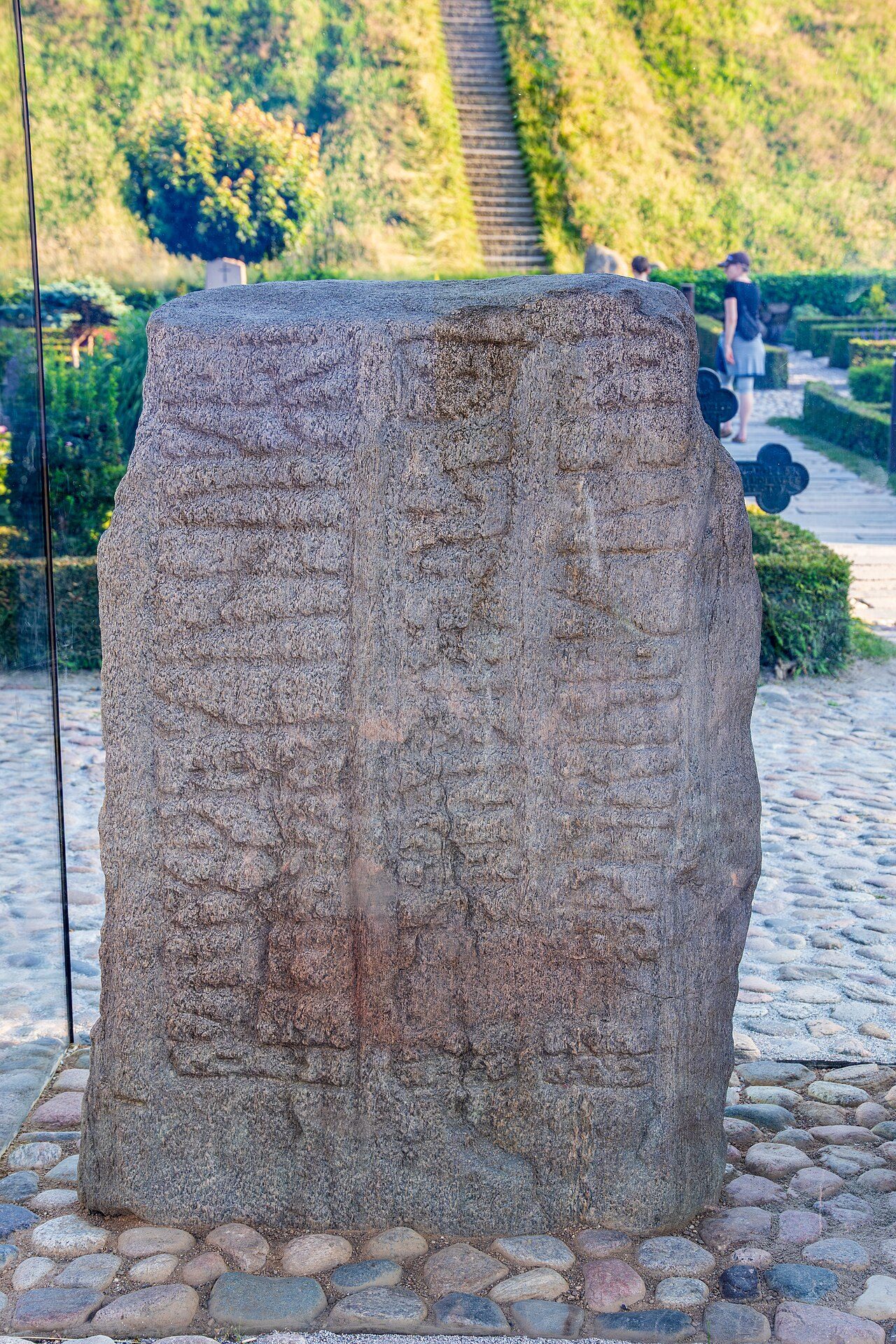
The small Jelling stone was raised by Gorm the Old, the first king of the Jelling dynasty, in memory of his wife Thyra (Old Norse Þyrvé, runic þurui). It stands at Jelling in central Jutland beside the larger stone raised by their son Harald Bluetooth, between two enormous burial mounds and in front of the stone church. The site, with the mounds, the church and the stones, was added to the UNESCO World Heritage List in 1994.
The text
The inscription runs in vertical lines over two faces: kurmR kunukR karþi kubl þusi aft þurui kunu sina tanmarkaR but, "King Gormr made this monument in memory of Þyrvé, his wife, Denmark's adornment." The phrase karþi kubl þusi uses the word kumbl, "monument, memorial", which can include not only the stone but the whole memorial complex. The final words, tanmarkaR but, are among the oldest records of the name Denmark in Denmark itself (the larger stone has the accusative form tanmaurk).
Runes and language
The runes are the long-branch Younger Futhark used in Viking Age Denmark. The sixteen runes had to serve for many more sounds: the kaun rune ᚴ writes both k and g (so kurmR is Gormr and karþi is gerði), and the ur rune ᚢ writes u, o, w and y (so þurui is Þyrvé). The rune yr ᛦ at the end of kurmR and kunukR writes the R-sound that came from Proto-Norse -z, still distinct from r in 10th-century Danish. The spelling kubl for kumbl shows that a nasal before a consonant was often not written.
Gorm and Thyra
Gorm died around 958; the burial chamber in the north mound at Jelling has been dated by tree rings to 958–959. The stone must be older than his death, so it belongs to the 940s or 950s. Thyra is otherwise known from later medieval Danish tradition, where she becomes a heroine credited with building the Danevirke defensive wall; the stone is the only contemporary evidence for her.
Where it stood
The stone has been moved at least once and its original position is uncertain; it was not necessarily raised beside the church, which is later than the stone. Today both Jelling stones stand side by side in climate-controlled glass cases, chosen through an architectural competition after a 2008 UNESCO inspection and a 2011 vandalism incident, so that they could be protected from weathering without being moved indoors.
Why it matters
Gorm's stone is a typical Viking Age memorial in form, "X made this monument in memory of Y", but it is also the first royal runestone of the Danish kingdom and the starting point of the dynastic program that his son completed on the large Jelling stone.
The full reading
§A kurmR kunukR karþi kubl þusi aft þurui kunu §B sina tanmarkaR but
- kurmR kunukR — King Gormr (Gorm)
- karþi kubl þusi — made this monument
- aft þurui kunu sina — in memory of Þyrvé (Thyra), his wife
- tanmarkaR but — Denmark's bót: its "adornment, pride" or "restoration, salvation" (see debates)
What scholars agree and disagree on
The reading of the runes is not disputed (Rundata DR 41; Jacobsen and Moltke 1941–42). Interpretation is.
- Who is "Denmark's bót"? Grammatically tanmarkaR but can describe Thyra ("his wife, Denmark's adornment") or Gormr ("Gormr, Denmark's ...", read as a separate phrase). Both readings have supporters; Rundata translates it as describing Thyra.
- What does bót mean? The word means "improvement, remedy, compensation". Translations include "Denmark's adornment", "Denmark's salvation" and "the restorer of Denmark"; the last reading has been linked to Thyra and the Danevirke in later tradition, but that link is not on the stone.
- Date and order of monuments. The relation between Gorm's stone, the mounds and the Viking Age enclosure discovered at Jelling since 2006 is under active archaeological study.
Sources
- Samnordisk runtextdatabas (Rundata), DR 41.
- Jacobsen, Lis & Moltke, Erik (1941–42), Danmarks Runeindskrifter, no. 41. Copenhagen: Munksgaard.
- Wikipedia, 'Jelling stones' (for checking).
Readings are given as facts with their source; translations on this page are our own.