

What to notice
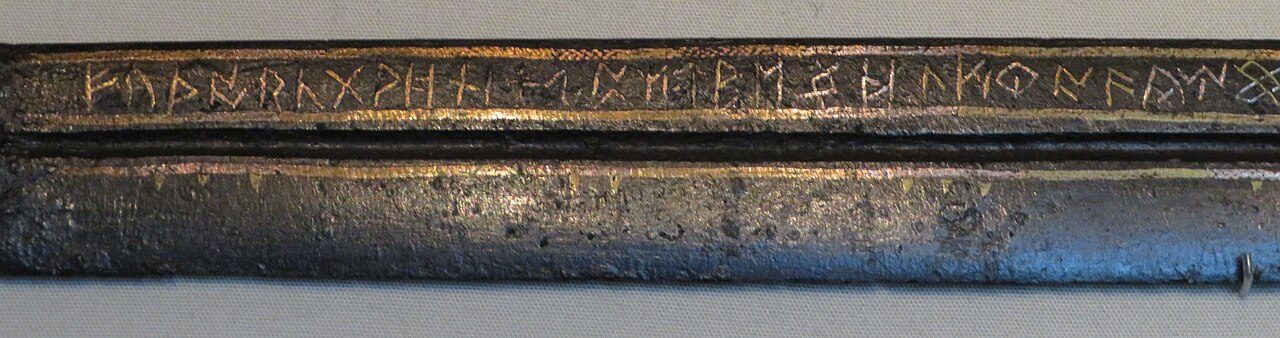
- The only complete 28-rune futhorc row in an inscription
- Runes inlaid in brass and silver wire, not cut
- The order ŋ d l m differs from every manuscript row
- The sigel rune ᛋ is tiny, squeezed in after the fact
The Seax of Beagnoth is an iron knife 72 cm long, with a single cutting edge and a long tapering point, of the type called a long seax. It was found in early 1857 by a laborer, Henry J. Briggs, in the River Thames near Battersea in London, and sold to the British Museum. On 21 May 1857 Augustus Wollaston Franks exhibited it at the Society of Antiquaries, and for a long time it was known as the "Thames scramasax".
A prestige weapon
Both faces of the blade are decorated. Strips of twisted copper, brass and silver wire were hammered into grooves cut in the iron, forming lozenges, triangles and herringbone bands. One face carries a lozenge pattern that may imitate pattern-welding. The other carries two inscriptions, inlaid in brass and silver wire: on the left the whole rune row, and on the right, separated by a herringbone panel, the name beagnoþ. The handle has not survived.
The only complete futhorc row in an inscription
The seax is the only object known to carry the full 28-letter Anglo-Saxon futhorc as an inscription. The English row grew from the 24-rune Elder Futhark by adding new runes for new sounds: ac, aesc, yr and ear at the end, and os for o in the fourth position. Manuscripts preserve the row and the rune names, notably the Old English Rune Poem and a 9th-century manuscript in Vienna; the seax shows the row as a craftsman reproduced it.
The order is not quite the manuscript order. The first nineteen runes are in the expected sequence, but the four after eh, namely ing, daeg, lagu and mann, stand in an order found nowhere else, and the last two, yr and ear, are swapped compared with the Vienna manuscript. The sigel rune is very small and looks squeezed in as an afterthought.
Unusual letter forms
Several runes have rare shapes: ger with a single bar, sigel in a form also found on St Cuthbert's coffin and similar to the Insular script letter s, daeg with its crossing strokes made into a triangle, ethel with a single stem, and yr with a cross in the middle. The scholar Ralph Elliott explained some of these as simplifications. Together with the confused order, they suggest that whoever designed the inscription was not a practiced rune-writer, or that inlaying wire forced some shapes.
Why it matters
Late Anglo-Saxon England used the Latin alphabet for almost all writing, and runes survived mostly as learned curiosities and on a few objects. The seax shows the full futhorc being displayed on a valuable weapon in the 9th or 10th century, long after runes had stopped being an everyday script in England. Compare the complete Elder Futhark on the Kylver stone, five centuries earlier.
The full reading
fuþorcgwhnijïpxstbeŋdlmœaæyea — the 28 runes of the Anglo-Saxon futhorc.
beagnoþ — Beagnoþ, a man's name, probably the owner or the smith.
What scholars agree and disagree on
- Why write the alphabet on a knife? Interpretations range from a protective or magical use of the row to simple decoration and a display of learning. Nothing on the blade decides between these; an alphabet row is also found on other early objects for which no purpose is stated.
- Who was Beagnoth? Either the owner or the smith. Both readings are common; RuneS gives only the name.
- Date. The British Museum and most handbooks give the 10th century; RuneS gives 800–1000. Birger Nerman (1959) and Vera Evison (1964) wrote on the dating and type of the weapon.
- Letter forms. Whether the odd forms are errors, craftsman's simplifications, or influence from manuscript letters (the s-rune and Insular s) is debated (Elliott; Page 1999).
Sources
- RuneS-Datenbank (Göttingen Academy of Sciences and Humanities), find no. 651, 'Sax von London, Thames' (OE-GB-52).
- Page, R. I. (1999), An Introduction to English Runes, 2nd ed. Woodbridge: Boydell.
- Elliott, Ralph W. V. (1989), Runes: An Introduction, 2nd ed. Manchester University Press (as cited in Wikipedia).
- Nerman, Birger (1959), 'The Dating of the Runic-inscribed scramasax from the Thames at Battersea' (from the RuneS literature list).
- Evison, Vera I. (1964), 'A Decorated Seax from the Thames at Keen Edge Ferry' (from the RuneS literature list).
- Wikipedia, 'Seax of Beagnoth' (for checking).
Readings are given as facts with their source; translations on this page are our own.