
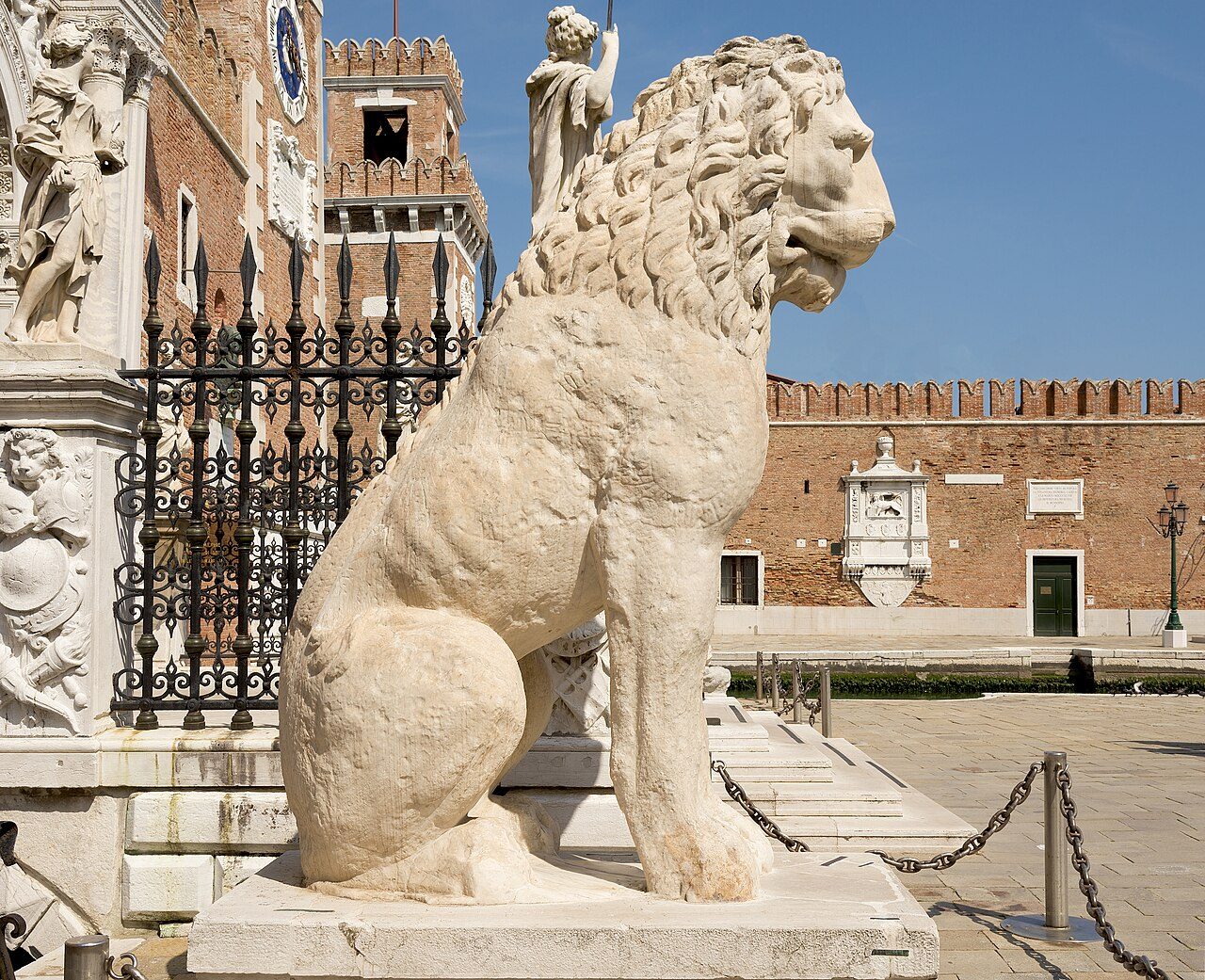

What to notice
- Viking Age runes on a 4th-century BC Greek statue
- Serpent bands like those on Uppland runestones
- Weathering has made most runes illegible; readings range from Rafn's saga to Jansson's fragments
- Taken from Athens to Venice in 1687
The Piraeus Lion is a seated marble lion about 3 m high, an ancient Greek sculpture of the 4th century BC that stood for centuries at the harbor of Piraeus, the port of Athens. It was so prominent that Italian sailors called the harbor Porto Leone. Accounts from the 16th and 17th centuries describe it as a fountain, with water running from its mouth into a cistern. In 1687, during the Venetian war against the Ottoman Empire, Venetian forces under Francesco Morosini took Athens; the lion was carried off as booty and has stood since 1688 outside the gate of the Arsenale, the naval dockyard of Venice. The lion of St Mark was the symbol of Venice, which may explain the choice.
Runes on a Greek lion
On the lion's shoulders and flanks are long bands shaped like serpents, the same design that frames inscriptions on 11th-century runestones in Sweden. They contain runes. In the late 18th century the Swedish diplomat Johan David Åkerblad recognized them as runic. The marble has weathered badly, and most of the runes can no longer be read with confidence.
Who carved them
Scandinavians reached Byzantium in numbers in the 10th and 11th centuries, many as Varangians, mercenaries in the emperor's guard; Swedish runestones commemorate men who died "in Greece" (í Grikkjum). The carvers of the Piraeus runes were probably such men, passing through or stationed at the harbor. The style of the right-hand band, with its dragon-headed serpent, closely matches runestones of Uppland in eastern Sweden and suggests a date in the late 11th century.
Readings old and new
Carl Christian Rafn published the first full reading in the 1850s, filling the many gaps with an elaborate story of Harald the Tall, Greek revolts and an expedition. Erik Brate's reading of 1914 was more cautious and attributed the carving to Svíar, Swedes. In 1984 Sven B. F. Jansson concluded that only scattered words could be read, and Rundata follows him: "these runes", "this harbor", "valiant men". In 2014 the runologist Thorgunn Snædal published a new study based on close inspection; she distinguishes three phases of carving and reads names such as Åsmund, Askel or Eskil and Torlev, a reference to a "harbor", and a memorial to a man who fell before he could collect tribute.
Why it matters
The lion is the southernmost runic monument of the Viking world, alongside graffiti in Hagia Sophia in Istanbul. It shows Scandinavians in the eastern Mediterranean bringing the habits of home, a memorial in a serpent band, to a classical statue. Compare the runic graffiti left by visitors in Maeshowe.
The full reading
Only fragments can be read. Rundata, following Sven B. F. Jansson (1984):
- §A ...ar þisar × þair × is-... — "... these [runes]. They ..."
- §B ... --fn þisi — "... this harbor."
- §C trikir ... — "valiant men ..."
Thorgunn Snædal's 2014 study, as presented by the Swedish History Museum, reads more, in translation: on the front left band "... they carved, men of the Helming clan(?) ... in this harbor these men carved runes in memory of Horse(?) the farmer ... he fell(?) before he could take the tribute"; on the right side "Åsmund carved ... these runes, they Eskil/Askel ... Torlev(?) and ...". Her readings are reconstructions of badly worn runes.
What scholars agree and disagree on
- How much can be read? Rafn's (1850s) reading is now regarded as largely imaginative. Brate (1914) and Jansson (1984) reduced the readable text to fragments. Snædal (2014) recovered more but her reconstructions depend on traces that others may read differently; they are presented as the most recent on-site study, not as a settled text.
- Who carved the runes. Brate thought of Swedes. The Swedish History Museum, presenting Snædal's work, stresses parallels with Uppland runestones, while a ScienceNorway report on the same study raised the possibility of Norwegian carvers for one band. A mixed Varangian company is also possible.
- Harald Hardrada. Attempts to find Harald Sigurðarson (Harald Hardrada), who served in Byzantium in the 1030s–40s, in the text are not supported by the dating of the runes.
- Signum. Rundata lists the lion under a provisional signum (By NT1984;32 in Rundata 2.5, after Jansson's 1984 article); there is no standard corpus number like those of the Scandinavian provinces.
Sources
- Samnordisk runtextdatabas (Rundata), By NT1984;32 (Rundata 2.5: X ByNT1984;32).
- Jansson, Sven B. F. (1984), 'Pireuslejonets runor', Nordisk Tidskrift för vetenskap, konst och industri.
- Snædal, Thorgunn (2014), study of the Piraeus Lion runes, as presented by the Swedish History Museum, 'The Piraeus Lion with Viking tattoos' (historiska.se).
- Brate, Erik (1914), reading of the Piraeus inscriptions (as cited in Wikipedia).
- Rafn, Carl Christian (1850s), reading of the Piraeus inscriptions (as cited in Wikipedia).
- Wikipedia, 'Piraeus Lion' and Swedish Wikipedia, 'Pireuslejonet' (for checking).
Readings are given as facts with their source; translations on this page are our own.