

What to notice
- Still standing on the grave mound where it was raised
- faihido, 'painted': runes were colored as well as carved
- runo: one of the earliest certain uses of the word 'rune'
- Written right to left
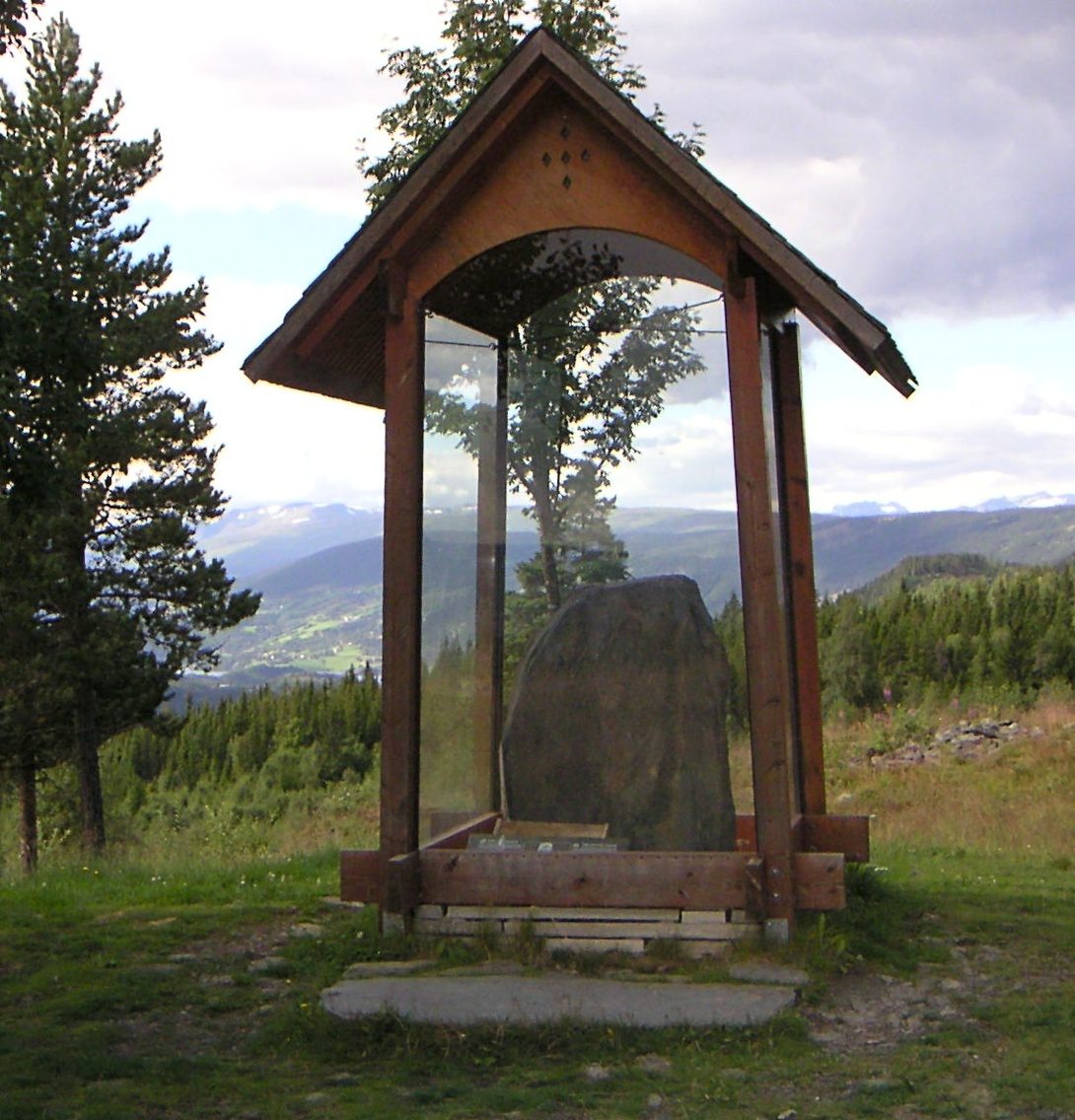
The Einang stone is a slab of slate about 1.5 m high standing on a grave mound at Einang, on a ridge above the Slidre fjord in Valdres, inland Norway. It is part of the Gardberg grave field, which has many other mounds. The stone is thought to be the oldest runestone in the world still standing where it was first raised. Today it is protected by a small timber shelter with glass walls.
The inscription
The single line reads right to left. Its beginning has flaked away, and what survives is ...dagastiz runo faihido. In 1938 the Danish runologist Erik Moltke proposed that about four runes were lost and restored the opening as [ek go], giving Ek Gōdagastiz rūnō faihidō, "I, Godagastiz, painted the rune." This restoration has been widely accepted, and Rundata follows it. The name Gōdagastiz means something like "good guest", with the same second element as Hlewagastiz on the Gallehus horn.
"Painted the rune"
The verb faihido is related to Old Norse fá, "to color, paint", and the same word is used on later stones: on the Rök stone, Varinn "colored" (fáði) the runes. It shows that runes were not only cut but colored, as traces of paint on many Viking Age stones also show. The noun runo is one of the earliest certain examples of the word rune itself. Grammatically it can be read as singular, "the rune", meaning a written message or inscription, rather than a single letter; it may also be a plural, "the runes". In either case it shows the word was used for a written text, not only for "secret" or "mystery", which is the older sense of the Germanic word.
A grave stone without the dead
The stone stands on a burial mound, so it is natural to read it as a grave marker. Yet the inscription names only the carver, not the person buried. Similar "carver only" texts are common in the oldest runic inscriptions, where the act of writing itself seems to have been worth recording. The stone's purpose cannot be decided from the text alone.
Why it matters
Einang is evidence for monumental runic writing in inland Norway by about the 4th century, it preserves the Proto-Norse endings -z and -ō (written with algiz and othala), and it gives the earliest secure appearance of the word runo on a runestone. Compare the Tune stone and the Kylver stone from the same centuries.
The full reading
[ek go]dagastiz runo faihido
- [ek go] — restored: "I, Go-"
- dagastiz — the end of a man's name, Gōdagastiz
- runo — "rune" or "runes, inscription"
- faihido — "painted, colored" (past tense, first person)
"[I, Go]dagastiz, painted the rune."
What scholars agree and disagree on
- The restoration [ek go]. Moltke's 1938 restoration is the generally accepted one and is used by Rundata; RuneS records the missing part only as about four lost runes, without committing to a name. Other names ending in -dagastiz are possible.
- runo: singular or plural. Krause read rūnō as accusative singular, "the rune (= the inscription)"; a plural reading is also possible. Either way it is the earliest certain example of the word on a stone.
- Date. Wikipedia and older handbooks give the 4th century; RuneS gives a broad late 2nd- to early 5th-century range, based on comparison with excavated mounds of the same grave field.
- Purpose. Grave marker or memorial for an unnamed dead person versus a monument to the carver's skill: open.
Sources
- Samnordisk runtextdatabas (Rundata), N KJ63.
- RuneS-Datenbank (Göttingen Academy of Sciences and Humanities), find no. 51, 'Stein von Einang' (N KJ63, NIæR 5).
- Krause, Wolfgang & Jankuhn, Herbert (1966), Die Runeninschriften im älteren Futhark, no. 63.
- Moltke, Erik (1938), restoration of the Einang inscription, as cited in Wikipedia and RuneS.
- Wikipedia, 'Einang stone' (for checking).
Readings are given as facts with their source; translations on this page are our own.