
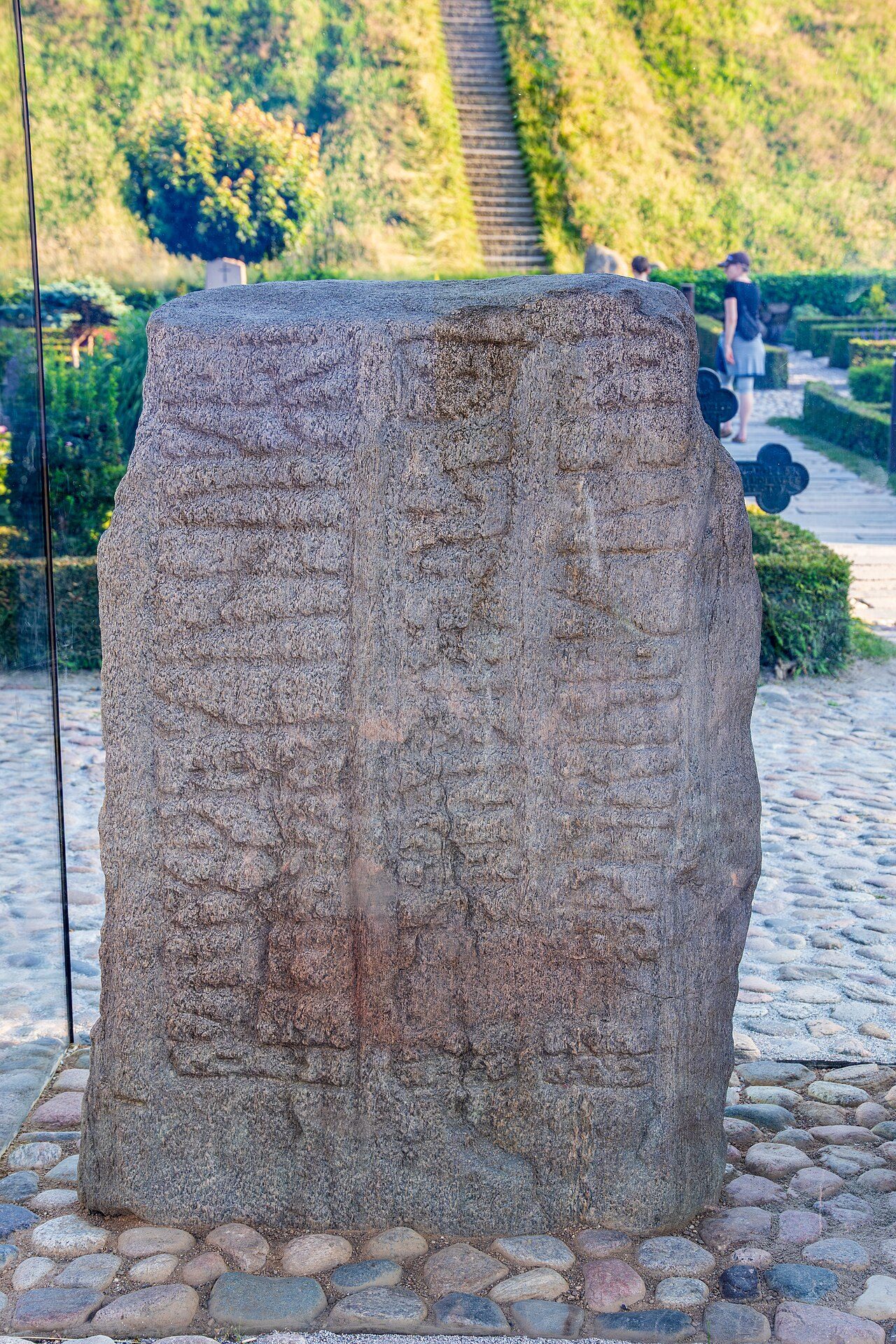

The smaller of the two Jelling stones (catalogue number DR 41) stands at Jelling church in Jutland, beside the larger stone his son Haraldr raised. Its text is eleven words long. On the stone it runs in three lines on one face and finishes on the back.
Which row is it?
Count the different runes and look at their shapes. A text from the 10th century in Denmark will be in the sixteen-rune Younger Futhark. Here it is written with long-branch runes: ᛅ with a full cross-stroke, ᚾ, ᛋ, ᛏ, ᛘ with their full branches. These fourteen runes are all you need:
The bold letter under each is its transliteration, the letter runologists use for it.
Find the word dividers
Most runestones separate words with a mark, usually one, two or more dots (᛫ ᛬) or a short cross. On this stone the first face uses one kind of divider and the back another, which is part of how we know where the text goes on.
Read the runes letter by letter
Write down the transliteration of each rune. Hide the letters below, try to read the runes with the chart above, then show them again. Click or tap a word for a note on it.
ᚴᚢᚱᛘᛦkurmRGormrGormr (Gorm)ᚴᚢᚾᚢᚴᛦkunukRkonungrkingᚴᛅᚱᚦᛁk(a)(r)þigerðimadeᚴᚢᛒᛚkublkumlmonument(s)ᚦᚢᛋᛁþusiþessitheseᛅᚠᛏa(f)(t)eptin memory ofᚦᚢᚱᚢᛁþuruiÞyrvéÞyrvé (Thyra)ᚴᚢᚾᚢkunukonuwifeᛋᛁᚾᛅsinasínahisᛏᛅᚾᛘᛅᚱᚴᛅᛦtanmarkaRDanmarkarDenmark'sᛒᚢᛏbutbótadornment / salvationClick a word.Letter by letter the stone reads:
kurmR : kunukR : k(a)(r)þi : kubl : þusi : a(f)(t) : þurui : kunu : sina : tanmarkaR : but
The brackets mark damaged runes: what is left of them fits these letters, but they are not certain. That is the reading of the Scandinavian Runic-text Database.
Undo the spelling conventions
Sixteen runes had to write a language with many more sounds, so each letter of the transliteration may stand for several sounds. Go through the words and try the alternatives:
Letter Can also be Here k g, ng kurmR → Gormr; karþi → gerði u o, ø, y, w kunu → konu; þurui → Þorwi a æ, e aft → æft t d tanmarkaR → Danmarkar þ ð karþi → gerði (nothing) m or n before b, d, g kubl → kumbl; kunukR → kunungR R the r of endings kurmR, kunukR, tanmarkaR You can try the same rules forward in the transliterator, and see how often they match what carvers actually did on the methodology page.
Recognise the formula and translate
Most runestones follow one pattern: who raised or made what, in memory of whom, who that person was to them, and sometimes something about the dead. This stone fits it exactly:
Old Danish (normalised)GormR kunungR gærþi kumbl þøsi æft Þorwi, kunu sina, DanmarkaR bot. Old West NorseGormr konungr gerði kuml þessi ept Þyrvé, konu sína, Danmarkar bót. EnglishKing Gormr made these monuments in memory of Þyrvé, his wife, Denmark's adornment.The last phrase is the hard part. Bót means improvement, remedy or adornment, and the grammar allows Danmarkar bót to describe either Þyrvé or Gormr, since it stands at the end after both names. Many readers take it as praise of the queen ("Denmark's adornment" or "Denmark's salvation"); others have argued it describes the king. Both readings have their supporters, and this is why translations of the stone differ.
Try another
The larger stone beside it, raised by their son Haraldr, uses the same formula and then adds his claims: read it here. For a stone that breaks every rule, see Rök.