
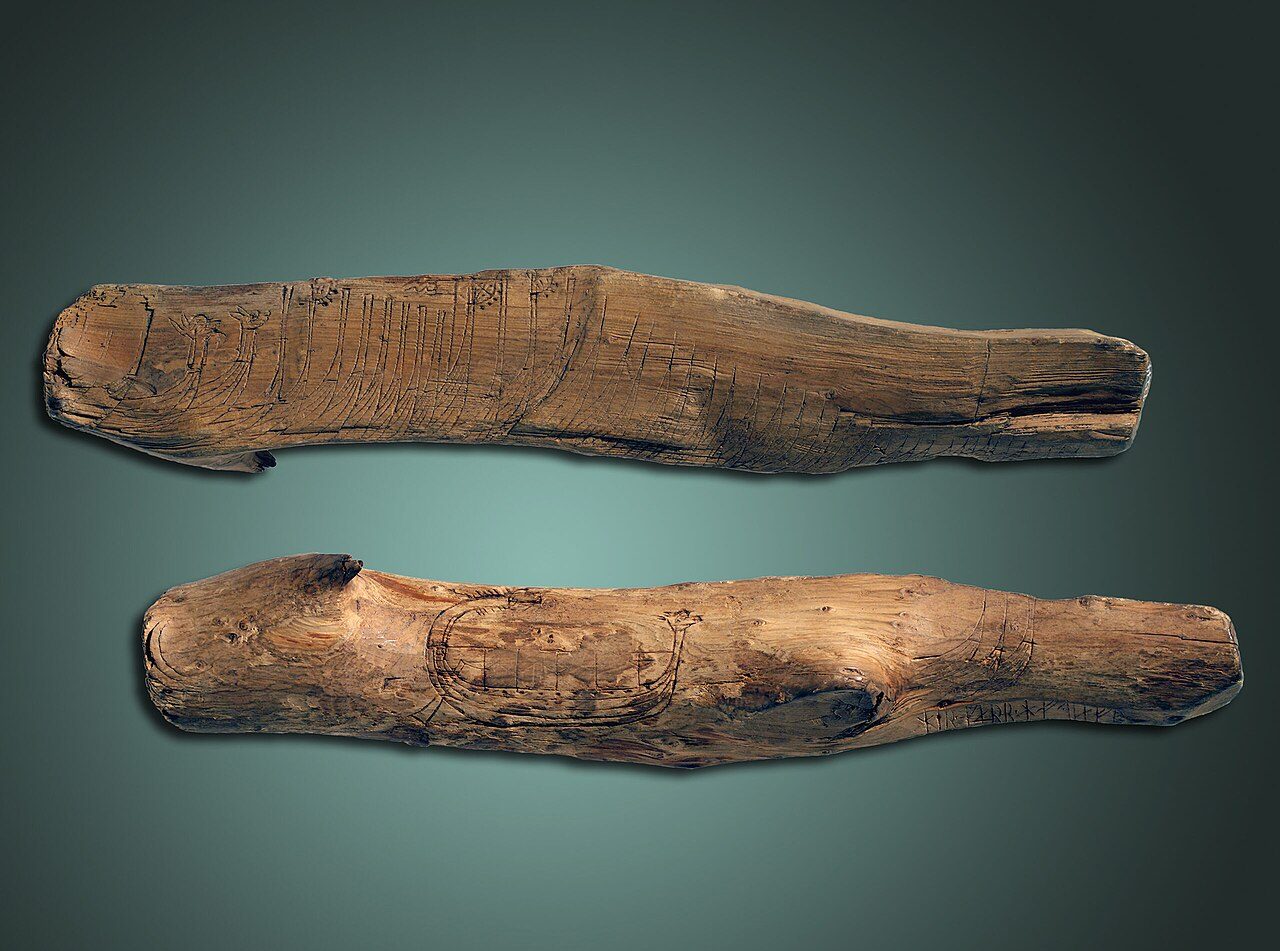

What to notice
- 'Ingibjǫrg loved me when I was in Stavanger' (N B390)
- 'Gyða says that you should go home' (N B149)
- Virgil's 'Love conquers all' in runes, beside a skaldic stanza (N B145)
- Owner's tags like 'Eysteinn owns me' (N B1)
Bryggen is the old wharf of Bergen on Norway's west coast, a row of timber merchant buildings along the harbor. After a fire in 1955 destroyed part of it, archaeologists excavated the site, and in the waterlogged layers beneath they found something no one expected: hundreds of everyday messages carved in runes on sticks of wood and pieces of bone. Some 670 runic inscriptions have now been found at Bryggen and nearby. They are cited with the letter B and a number (N B1, N B390 and so on) and are kept in Bryggens Museum.
Why the find changed runology
Before Bryggen, runes were known mostly from memorial stones and a few objects, and many scholars assumed they had gone out of everyday use in Norway long before the 14th century. The Bergen sticks showed the opposite. Merchants, craftsmen, sailors and townspeople used runes for practical writing, for fun and for love, side by side with the Latin alphabet used in charters and books. Many are dated by their layers to the 12th–14th centuries. The find has been called the most important runic discovery of the 20th century.
Featured sticks
N B390 is a short line of personal memory: "Ingibjǫrg loved me when I was in Stavanger." Nothing else is known of Ingibjǫrg or the writer; the stick may record a boast, a joke or a regret.
N B149 is a domestic message: "Gyða says that you should go home." It is often read as a wife summoning her husband from the wharf or the tavern. Its other side remains unread.
N B145 shows the range of runic literacy in a medieval town. One side carries a skaldic stanza in the complex meter dróttkvætt, full of kennings, about love-sickness for a beautiful woman, with an allusion to norns. The other carries, twice, a line of Virgil in Latin, written in runes: Omnia vincit Amor; et nos cedamus Amori, "Love conquers all; let us too yield to Love." The writer knew both Norse court poetry and classical Latin school texts.
Ordinary use
Many sticks are owner's tags, such as N B1, Eysteinn á mik, "Eysteinn owns me", which were tied to goods in transit. Others are business letters and orders, rune rows (N B17 has the row and then Ást mín, kyss mik, "My love, kiss me"), prayers and Latin religious formulas, and verse. One wax-tablet letter (N B368) urges its recipient to change sides in Norway's civil wars.
Runes
The sticks use the medieval Norwegian runic alphabet: the 16 runes of the Younger Futhark expanded with dotted runes to distinguish e from i, y from u, g from k, d from t and p from b. Spellings such as inkebiørk and sþafakri show how carvers handled sounds the old row could not separate. See medieval runes and compare the 12th-century graffiti in Maeshowe.
The full reading
Featured sticks (Rundata readings; my translations):
- N B390 — inkebiørk uni mer þa er ek uar i sþafakri — Ingibjǫrg unni mér þá er ek var í Stafangri. "Ingibjǫrg loved me when I was in Stavanger."
- N B149 — §A gya : sæhir : at þu : kak hæim — Gyða segir at þú gakk heim. "Gyða says that you should go home." (Side B is unread.)
- N B145 — a skaldic stanza in the meter dróttkvætt about the poet's love for a beautiful, dangerous woman, using kennings such as "the crag-norns' old fair wind" for the poet's mind or passion; then twice the Latin line omnia uinciþ amor æþ nos cedamus amori — Omnia vincit Amor, et nos cedamus Amori, "Love conquers all; let us too yield to Love" (Virgil, Eclogues 10.69).
- N B17 — fuþork hnias tbmly / ost min kis mik — the rune row, then Ást mín, kyss mik, "My love, kiss me."
- N B1 — øystein a mi(k) — Eysteinn á mik, "Eysteinn owns me": a typical owner's tag.
What scholars agree and disagree on
- Dating. Most sticks are dated by the excavation layers between known Bergen fires (for example 1198, 1248 and 1332); individual dates can be uncertain by decades.
- Readings of verse. The skaldic stanza on N B145 is hard, and editors differ in how they resolve its kennings; Rundata gives a Norwegian, not an English, translation.
- N B390. The sense of unni mér ("loved me") is clear; whether it records a real affair, a boast or a line of a song is unknowable.
- N B149. "Gyða says you should go home" is generally read as a wife's message, but Gyða's relation to the recipient is not stated.
- Runes and Latin. How far rune-writing in Bergen reflects schooling in Latin (as N B145 suggests) or a separate vernacular tradition is discussed in work by Terje Spurkland and others.
Sources
- Samnordisk runtextdatabas (Rundata), N B1, N B17, N B145, N B149, N B368, N B390.
- Norges innskrifter med de yngre runer (NIyR), vol. 6: Bryggen i Bergen (Liestøl, Aslak; Johnsen, Ingrid Sanness; Knirk, James E.), Oslo 1980–90 (standard edition; not consulted directly).
- Spurkland, Terje (2005), Norwegian Runes and Runic Inscriptions, trans. Betsy van der Hoek. Woodbridge: Boydell.
- Virgil, Eclogues 10.69 (public-domain Latin text).
- Wikipedia, 'Bryggen inscriptions' (for checking).
Readings are given as facts with their source; translations on this page are our own.