
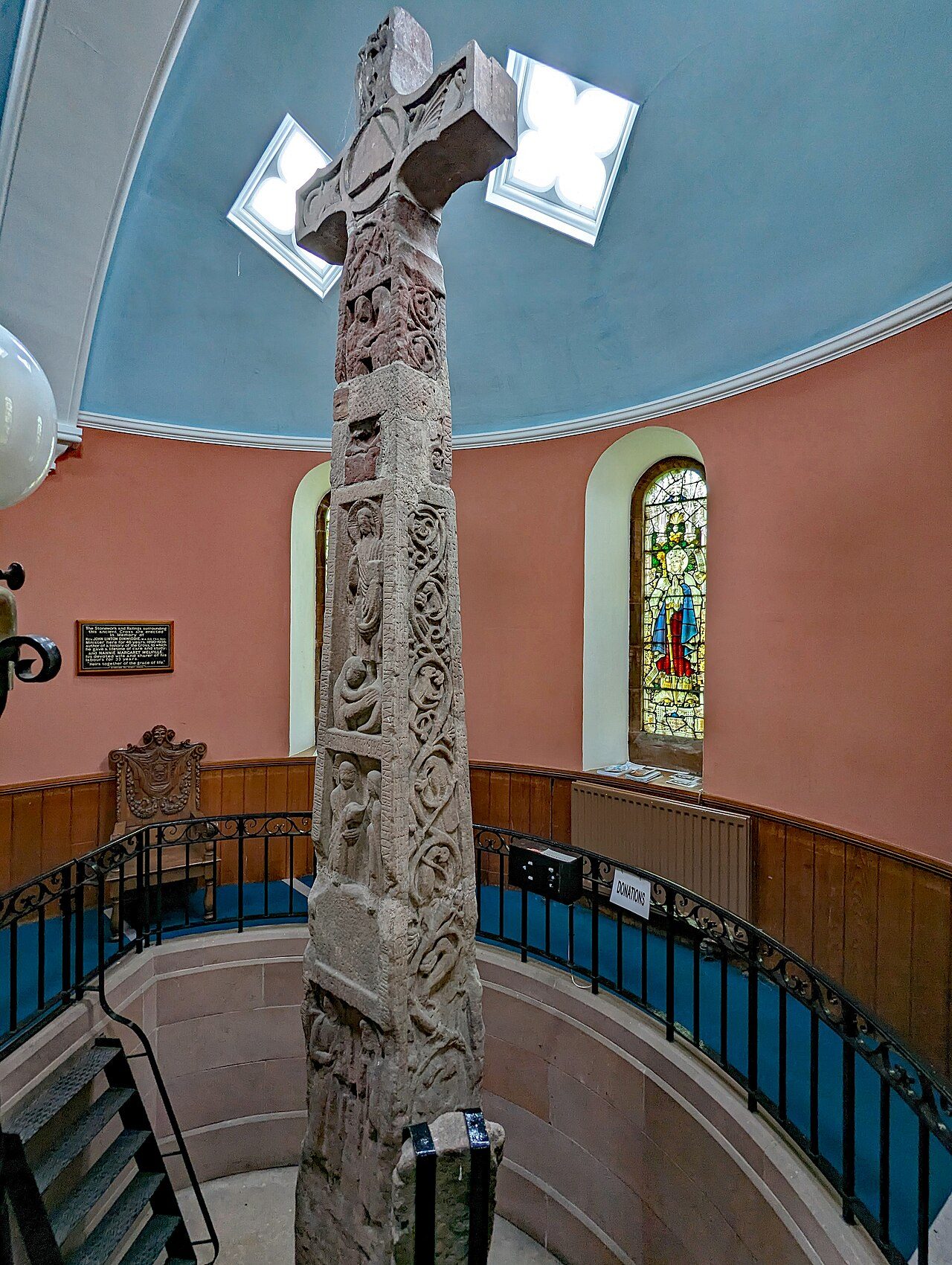

What to notice
- The Cross speaks: verses of The Dream of the Rood in runes
- Runes on the narrow sides, Latin in Roman letters on the broad sides
- Extra runes for Northumbrian g and k sounds
- Smashed in 1642, reassembled in 1823
The Ruthwell Cross is a sandstone cross about 5.5 m high that stands inside the parish church of Ruthwell, near the Solway Firth in southwest Scotland. When it was carved, in the 8th century, Ruthwell lay in the Anglo-Saxon kingdom of Northumbria. It is the most elaborate surviving Anglo-Saxon cross, with large figure panels and inscriptions in two alphabets and two languages.
Destruction and restoration
The cross survived the Reformation of the 16th century, but in 1640 the General Assembly of the Church of Scotland ordered "idolatrous monuments" to be destroyed, and in 1642 the cross was pulled down and broken. The pieces lay in and around the church; one is said to have served as a bench. In 1823 the minister Henry Duncan gathered the surviving fragments and re-erected the cross in the manse garden, with a new crossbeam because the original was lost. In 1887 it was moved into the church, into an apse built to hold it. The side arms of the head are modern guesses.
Two languages, two alphabets
The broad faces carry figure scenes from the Gospels and the lives of saints, framed by Latin inscriptions in Roman letters: Christ recognized by the beasts in the desert, Paul and Anthony breaking bread, Mary Magdalene washing Christ's feet, the Annunciation. The narrow faces are carved with an inhabited vine scroll, and around its borders run runes in Old English. The runes were recorded around 1600 by Reginald Bainbrigg for William Camden, but no one could read them correctly until the 19th century.
The Dream of the Rood
In 1840 and 1842 John Mitchell Kemble showed that the runic text corresponds to part of The Dream of the Rood, an Old English poem preserved in the Vercelli Book, a manuscript of the late 10th century kept in Vercelli in northern Italy. In the poem a dreamer sees the Cross, which speaks of the Crucifixion from its own point of view. On the Ruthwell monument the stone itself takes that voice: "I raised up a mighty king ... I dared not bend ... I was drenched with blood." The runic text is shorter and in an earlier, Northumbrian form of English than the manuscript.
Why it matters
If the runes are as old as the sculpture, the Ruthwell verses are among the oldest surviving English poetry, two centuries older than the manuscript. The text also shows how the English futhorc grew to write its sounds: it uses extra runes for the back (velar) g and k sounds, among them gar, which do not exist in the Scandinavian rows. Runologists transliterate them with capital G and a special K. Like the Franks Casket, Ruthwell places runes on a learned Christian object made in a Northumbrian church setting, a reminder that in England runes were not a pagan script.
The full reading
The runic text is a poem spoken by the Cross, close to lines 39–64 of The Dream of the Rood. Main passages, with lost runes restored in brackets (my translation):
- [on]geredæ hinæ god almeȝttig þa he walde on galgu gistiga modig f[ore allæ] men — "Almighty God stripped himself when he would climb onto the gallows, brave before all men."
- [ahof] ic riicnæ kyninc heafunæs hlafard hælda ic ni dorstæ — "I raised up a mighty king, the lord of heaven; I dared not bend."
- [b]ismæradu uŋket men ba ætgad[re] ic [wæs] miþ blodæ [b]istemi[d] — "Men mocked us both together; I was drenched with blood."
- krist wæs on rodi hweþræ þer fusæ fearran kwomu æþþilæ til anum ic þæt al bi[heald] — "Christ was on the cross. Yet eager ones came from afar, nobles, to the one alone; I beheld all that."
- [m]iþ s[t]re[l]um giwundad alegdun hiæ hinæ limwœrignæ gistoddun him [æt his licæs heafdum] — "Wounded with arrows. They laid him down, limb-weary; they stood at his body's head."
What scholars agree and disagree on
- How old are the runes? Most scholars date the sculpture to the 8th century; whether the runic poem was carved at the same time or added later is debated. RuneS records Page's estimate of c. 750 for the runes. The date matters for the claim that these are the oldest English verses (alongside early copies of Cædmon's Hymn).
- Kemble's restorations. Much of the runic text is damaged, and the standard reading supplies missing words from the Vercelli Book. Critics (O'Neill 2005) have pointed out that this risks reading the manuscript into the stone; the relationship between the two texts (common source, adaptation, or one from the other) is open.
- Cross or column? Fred Orton (1998) and Patrick Conner (2008) argued that the lower stone may not originally have belonged to a standing cross, and preferred "Ruthwell monument". Most writers still call it a cross.
- The program. Whether the images and inscriptions form one planned scheme is debated; the Crucifixion panel is thought to be later, and the two halves of the shaft may have been reassembled the wrong way round in 1823.
- Special runes. The exact values of the extra velar runes are discussed in detail by Page (1999) and in RuneS (transliteration after Majewski 2022).
Sources
- RuneS-Datenbank (Göttingen Academy of Sciences and Humanities), find no. 663, 'Kreuz von Ruthwell' (OE-GB-69), transliteration after Majewski (2022).
- Page, R. I. (1999), An Introduction to English Runes, 2nd ed. Woodbridge: Boydell.
- Kemble, John M. (1840, 1842), papers on the Anglo-Saxon runes, Archaeologia 28 and 30 (as cited in Wikipedia).
- Orton, Fred (1998), 'Rethinking the Ruthwell Monument', in Cassidy (ed.), The Ruthwell Cross (as cited in Wikipedia).
- Conner, Patrick W. (2008), on the Ruthwell monument (as cited in Wikipedia).
- The Dream of the Rood, Vercelli Book (Vercelli, Biblioteca Capitolare CXVII), lines 39–64: public-domain Old English text, used for comparison.
- Wikipedia, 'Ruthwell Cross' (for checking).
Readings are given as facts with their source; translations on this page are our own.