

What to notice
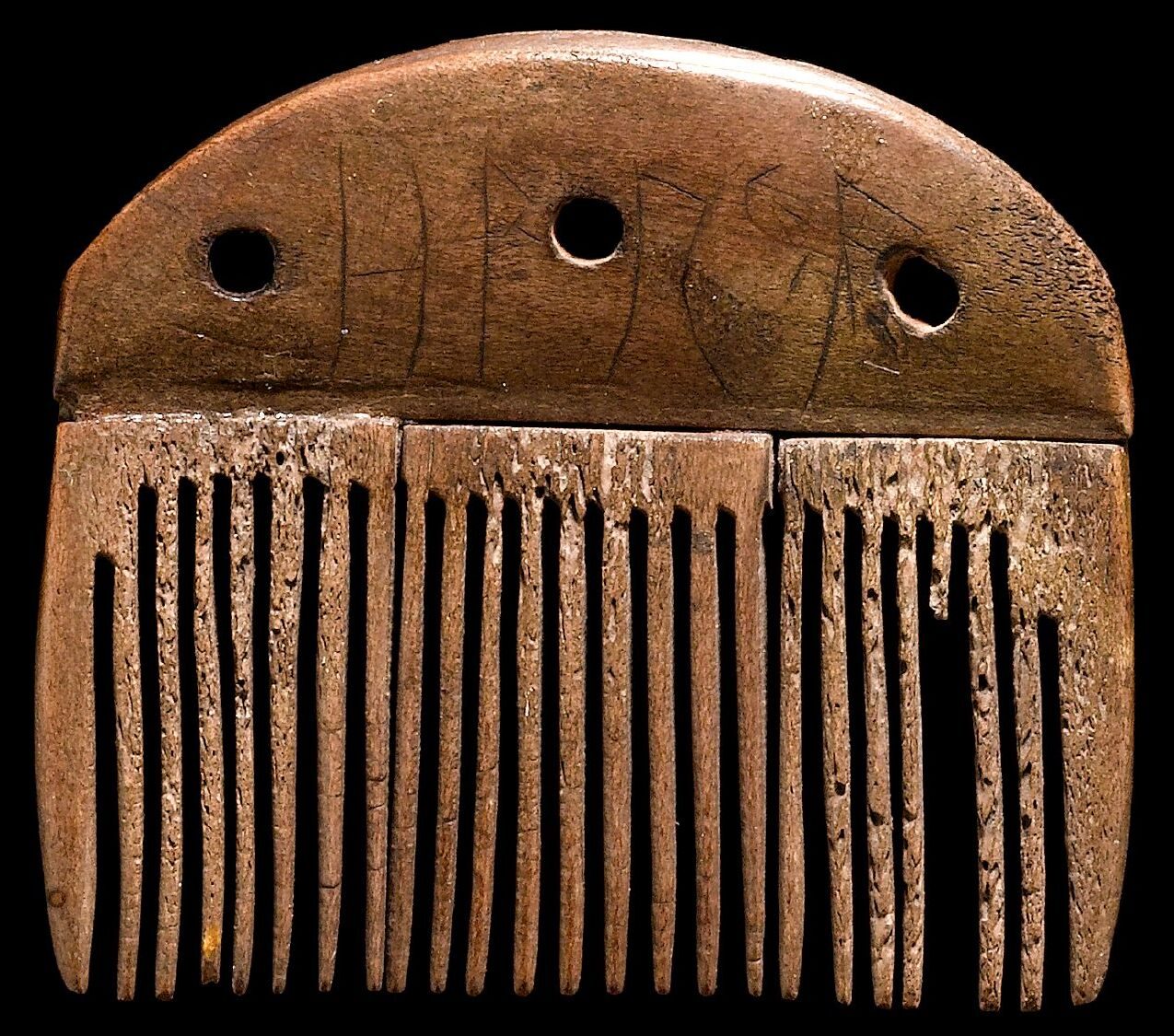
- Only five runes, but dated by archaeology to about AD 150
- The jera rune ᛃ in one of its earliest securely dated forms
- Harja is built on the Germanic word for 'army', as in Old Norse herr
The Vimose comb is a small comb of antler, about 5.6 cm wide, found in 1865 in the Vimose bog on the island of Funen in Denmark. On one side of its back, between the rivet holes, five runes are cut: harja. With an archaeological date in the middle of the 2nd century AD, it belongs to the small group of the very earliest runic inscriptions, and it is often called the oldest runic text that can be dated with some confidence.
The find and its context
Vimose was a lake that slowly became a bog, and in the Roman Iron Age people deposited large quantities of weapons and equipment in it. Archaeologists read these deposits as offerings of war booty: after a battle, the victors destroyed and sank the gear of a defeated army. Excavations in the 19th century, led above all by Conrad Engelhardt, recovered thousands of objects from several separate depositions. The comb belongs to one of the earlier ones. Its type, a two-layer comb held together with iron rivets, is dated by comparison with combs from other bog finds such as Kragehul to around AD 150, and the RuneS research database gives c. 140–160. Several other objects from the same bog carry runes too: a plane, a buckle, a sword chape and a scabbard fitting, so the comb is one item in an important early cluster.
The text
The five runes are hagalaz, ansuz, raido, jera and ansuz again. They spell a single word, Harja, which almost all scholars take as a man's name in the nominative case. It is related to the Germanic word for an army (Gothic harjis, Old Norse herr), and names built on that stem are common in later Germanic tradition. The ending -a marks a weak (n-stem) masculine name. The most natural reading is that Harja was the comb's owner, though a maker's signature cannot be ruled out.
Why it matters
The comb shows that by the middle of the 2nd century the runic alphabet was already in use in southern Scandinavia for writing short, personal texts on portable objects. It also shows the shape of the earliest runes: angular strokes suited to cutting into wood, bone and metal, with no curved lines. The jera rune here, written as two angled hooks, is one of the earliest securely dated examples of that letter.
The language is so early that it is hard to call it either Proto-Norse or Proto-Germanic; the word harja would look much the same in either. That is typical of the oldest runic finds, which come from a time before the North Germanic languages had clearly split from the rest. Compare the other very early inscriptions on this site, the Øvre Stabu spearhead from Norway, and the later full sentence on the Gallehus horn.
The full reading
harja — Harja, a personal name, probably the comb's owner (or maker).
What scholars agree and disagree on
The reading harja is not disputed; the runes are clear. Discussion concerns what the word is and how old the comb is.
- Name or something else? The standard editions, Krause and Jankuhn (1966) and Looijenga (2003), and the Rundata and RuneS databases all take Harja as a personal name. Because the stem means "army", it could in principle be a by-name ("warrior") rather than a given name; the comb itself cannot settle that.
- Owner or maker? The inscription does not say. A short name on a personal object is usually taken as an owner's mark.
- "Oldest" runic inscription. The comb is often called the oldest datable runic inscription, but that title is shared or contested. The Øvre Stabu spearhead and some other Danish and German finds are of similar age, and the brooch from Meldorf (1st century AD) carries marks that some read as runes and others as Roman letters. What is settled is that the Vimose comb is among the very earliest secure runic texts, dated by archaeology rather than by the runes themselves.
Sources
- Samnordisk runtextdatabas (Rundata), DR 207.
- RuneS-Datenbank (Göttingen Academy of Sciences and Humanities), find no. 20, 'Kamm von Vimose' (Fyn 19, KJ 26).
- Krause, Wolfgang & Jankuhn, Herbert (1966), Die Runeninschriften im älteren Futhark, no. 26.
- Looijenga, Tineke (2003), Texts and Contexts of the Oldest Runic Inscriptions. Leiden: Brill.
- Wikipedia, 'Vimose inscriptions' (for checking).
Readings are given as facts with their source; translations on this page are our own.