

What to notice
- One of the few runic texts in Gothic, an East Germanic language
- hailag is the Gothic cognate of English holy
- The seventh rune was cut through by a thief in 1875; its reading is still debated
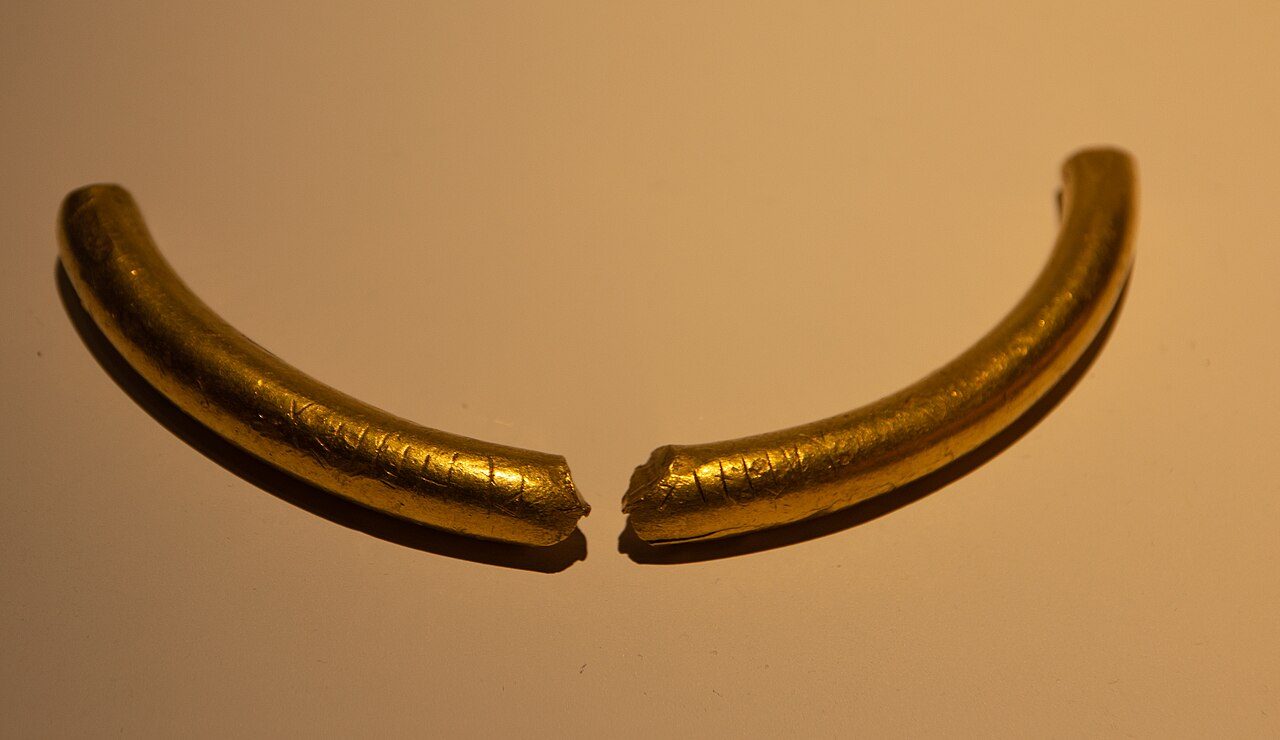
The Ring of Pietroassa is a gold neck-ring, about 16 cm across, that formed part of a large gold hoard found in 1837 on Istrița hill near the village of Pietroasa (today Pietroasele) in Buzău County, Romania. The hoard originally had 22 objects weighing about 20 kg in total, among them vessels, a patera (libation dish), brooches shaped like eagles and two neck-rings. One of the rings carries a short inscription in the Elder Futhark, the most important runic text in the Gothic language.
A hoard with a turbulent history
The finders broke up and sold part of the hoard, and ten objects were lost soon after the discovery. The rest went to the museum in Bucharest. In 1875 the treasure was stolen from the museum; when it was recovered, the inscribed ring had been cut into pieces, and the cut ran through the seventh rune, destroying most of it. Accounts differ on whether the thief or a goldsmith he dealt with did the cutting. Drawings, a cast and a photograph made by the Arundel Society in London before 1875 survive and are the main evidence for the lost rune. In 1916, during the First World War, the treasure was sent to Moscow for safekeeping; it came back to Romania only in 1956.
Date and owner
The hoard is usually dated to the late 4th or the first half of the 5th century, in the period when Gothic groups lived north of the lower Danube. Romanian scholars of the 19th century linked it with the Gothic leader Athanaric (died 381); more recent work has suggested Gainas, a Gothic general in Roman service killed in 400, or simply an unnamed Gothic elite. None of these links can be proved. The gold and the craftsmanship point to Roman-Mediterranean workshops for much of the hoard.
The inscription
As recorded before the damage, the ring reads gutaniowi hailag. The first word is generally accepted as a form of the name of the Goths, and the last, hailag, as the Gothic word for "holy" (compare English holy, Old Norse heilagr). The middle is the problem: the damaged seventh rune, read as othala from the early drawings, and the following wi. Many scholars follow Wolfgang Krause in taking o as a single rune standing for its name (ōþal, "inherited property") and wi as wīh, "consecrated", giving roughly "the inheritance of the Goths, sacred and inviolable".
Why it matters
Pietroassa is one of very few runic texts in an East Germanic language, the branch to which Gothic belongs and which is otherwise known mainly from Wulfila's 4th-century Bible translation in its own Gothic alphabet. It shows that runes were used among the Goths before or alongside that alphabet, and in a ceremonial context. Compare the Proto-Norse texts of the same age from Scandinavia, such as the Gallehus horn.
The full reading
gutani o wi hailag, as usually segmented:
- gutani — "of the Goths" (or a related form of the Goths' name)
- o — the damaged seventh rune; often taken as an abbreviation, see debates
- wi — perhaps wīh, "holy, consecrated"
- hailag — "holy, sacrosanct"
One widely cited rendering (after Krause 1966, followed by Düwel): "sacred inheritance of the Goths, inviolable." Other scholars translate quite differently.
What scholars agree and disagree on
The damaged seventh rune and the division of gutaniowi into words have produced many readings. Summarizing the main ones:
- Krause (1966), Düwel (2001): gutanī ō[þal] wī[h] hailag, "inheritance of the Goths, sacred (and) inviolable", with ᛟ standing for its rune-name.
- Reichert (1993), Nedoma (1993): the damaged rune was ᛃ, read as j[ēra], "(good) year"; Nordgren (2004) connected this with sacral kingship.
- Looijenga (1997): the damaged rune was ᛋ, giving gutanīs wī[h] hailag, "Gothic (object), sacrosanct".
- Pieper (2003): reads an ŋ-rune and finds a dedication to Ingwin of the Goths.
- Earlier readings include "to the Jove (Thor) of the Goths" (Diculescu 1923) and a dedication to Gothic mother-goddesses (Krogmann 1978).
What is agreed: the language is Gothic, the first element names the Goths, hailag means "holy", and the text is religious or ceremonial in character. What remains open: the seventh rune, the grammar of gutani-, and the exact sense of the whole. The pre-1875 Arundel Society photograph is the strongest evidence and supports a ᛟ-like shape.
Sources
- RuneS-Datenbank (Göttingen Academy of Sciences and Humanities), find no. 38, 'Ring von Pietroasele' (KJ 41).
- Krause, Wolfgang & Jankuhn, Herbert (1966), Die Runeninschriften im älteren Futhark, no. 41.
- Looijenga, Tineke (1997/2003), Texts and Contexts of the Oldest Runic Inscriptions. Leiden: Brill.
- Düwel, Klaus (2001), Runenkunde, 3rd ed. Stuttgart: Metzler.
- Wikipedia, 'Ring of Pietroassa', 'Pietroasele treasure' and 'Gothic runic inscriptions' (for checking).
- romaniancoins.org, 'The Pietroasa treasure' (on the 1875 theft), for checking.
Readings are given as facts with their source; translations on this page are our own.