

The word
Old Norse rún, Old English rūn and Gothic rūna all mean "secret" or "mystery" as well as a written character; in Old English the word also meant a whispered conversation or counsel. When Wulfila translated the Gospels into Gothic in the 4th century, he used rūna for the Greek mystērion. The sense of secrecy is in the word, but it does not mean the runes themselves were hidden knowledge: thousands of ordinary inscriptions show people of many ranks reading and writing them. The modern word rune came into English in the 17th century from scholarly Latin runa, which antiquarians had taken from the Scandinavian languages.
The name futhark is modern too. It is formed from the first six runes of the row, ᚠᚢᚦᚨᚱᚲ f u þ a r k, the way alphabet comes from alpha and beta. The English row is called the futhorc because sound changes gave its fourth rune the value o.
Where the runes came from
No source tells us who made the runes, and the question has been argued since the 19th century. What is agreed is that the runic row was not invented from nothing: several runes look like letters of Mediterranean alphabets with the same sound (ᚠ f, ᚱ r, ᚺ h, ᛒ b, ᛊ s), and the angular shapes suit cutting across the grain of wood. Three models have had serious support:
- Latin. The Roman alphabet was the one Germanic peoples met most, through trade, coinage and service in the Roman army. Ludvig Wimmer argued for it in 1874, and many runologists, including Erik Moltke, Bengt Odenstedt and Michael Barnes, regard it as the likeliest source or at least the main one.
- North Italic (Alpine) alphabets. Carl Marstrander (1928) and later Magnus Hammarström pointed to the Etruscan-derived alphabets of the Alps, used until about the 1st century BC; the Negau helmet B, with a Germanic name in a North Etruscan alphabet, shows Germanic speakers using such letters. The chronological gap to the first runic finds is the weakness.
- Greek. Sophus Bugge and Otto von Friesen argued that Goths on the Black Sea adapted Greek cursive in the 3rd century. Older runic finds from Denmark and Norway have since made this impossible as an origin, though it is part of the history of the debate.
Most scholars now think the runes were created by someone who knew a classical alphabet, probably Latin, somewhere in or near southern Scandinavia, around the turn of the eras or in the 1st century AD, and that the creator reshaped and reordered the letters freely: the runic order fuþark is like no Mediterranean alphabet, and nobody has explained it.
The earliest finds
The oldest securely dated runic inscriptions come from the second half of the 2nd century AD, most of them from the great bog deposits of Denmark, where defeated armies' equipment was sacrificed. The Vimose comb from Funen reads harja, probably a man's name; the Øvre Stabu spearhead from Norway reads raunijaz, "tester", a name for the weapon. Spearheads and shield fittings from Illerup Ådal in Jutland carry short runic names from around AD 200.
Two finds may be older. The Meldorf brooch from Holstein, from the early 1st century AD, has four signs that some read as runes and others as Latin letters. The Svingerud stone from Hole in Norway, published in 2023 by the Museum of Cultural History in Oslo, was found in a grave dated by radiocarbon to between about AD 1 and 250, which would make it the oldest datable runestone if the stone and the burial belong together.
The Elder Futhark: names, owners and bracteates
For its first four or five centuries the Elder Futhark was used for short texts on portable objects: a name on a comb or a brooch, a maker's line on a drinking horn (Gallehus), a word on a spearhead. Several hundred Elder Futhark inscriptions are known in all, spread from Norway to the Black Sea. The language is Proto-Norse in Scandinavia, an ancestor of Old Norse; finds on the continent and in England are in early West Germanic dialects, and the Pietroassa ring from Romania is in Gothic.
From the 5th century come the first runestones, in Norway and Sweden: memorial and grave stones such as Tune and Einang. The same period produced hundreds of gold bracteates, thin stamped medallions modelled on Roman imperial medals, some with runic words such as alu and laþu (meanings debated: "ale" and "invitation" are among the proposals) and several with the whole futhark, as on the Vadstena bracteate. The order of the row is known from such complete rows, the oldest on the Kylver stone from Gotland, around 400.
England and Frisia: a longer row
Settlers from the continent brought runes to Britain in the 5th century. As Old English and Frisian sounds changed, the old a-rune split into āc, æsc and ōs, and new runes were added, until the English row had 28 runes and, in Northumbria, more. The Undley bracteate may be the oldest English inscription. The great English monuments are Christian: the Franks Casket, with its riddle on the whale and scenes from Germanic legend, Roman history and the Gospels, and the Ruthwell Cross, carved with lines of the poem we call The Dream of the Rood.
English runes also lived in manuscripts. Scribes used single runes as abbreviations (ᛗ for man, ᛟ for ēþel, homeland), the poet Cynewulf signed four poems by weaving the runes of his name into the verse, and the Old English Rune Poem survived in a manuscript until the fire of 1731. Runic writing in England faded in the 10th and 11th centuries.
How 24 runes became 16
In Scandinavia the opposite happened. Over the 7th and 8th centuries, while Proto-Norse was gaining new vowel sounds, carvers stopped using eight runes and let the remaining sixteen stand for more sounds each. The change can be watched on stones from Blekinge such as Björketorp and Stentoften, which use old and new forms side by side, and it was complete by the time a short inscription was cut on a piece of human skull in Ribe, in Denmark, around 725. Why a script would shrink just as the language needed more letters is one of the classic problems of runology. Proposed reasons include the loss of rune names that no longer began with their sound, simplification of shapes, and a deliberate reform; no explanation has won general agreement.
The result, the Younger Futhark, came in two main forms: long-branch runes, common on Danish stones, and short-twig runes, quicker to cut, used in Sweden and Norway, especially on wood. In Hälsingland a third variant without vertical staves was used.
The Viking Age: runestones
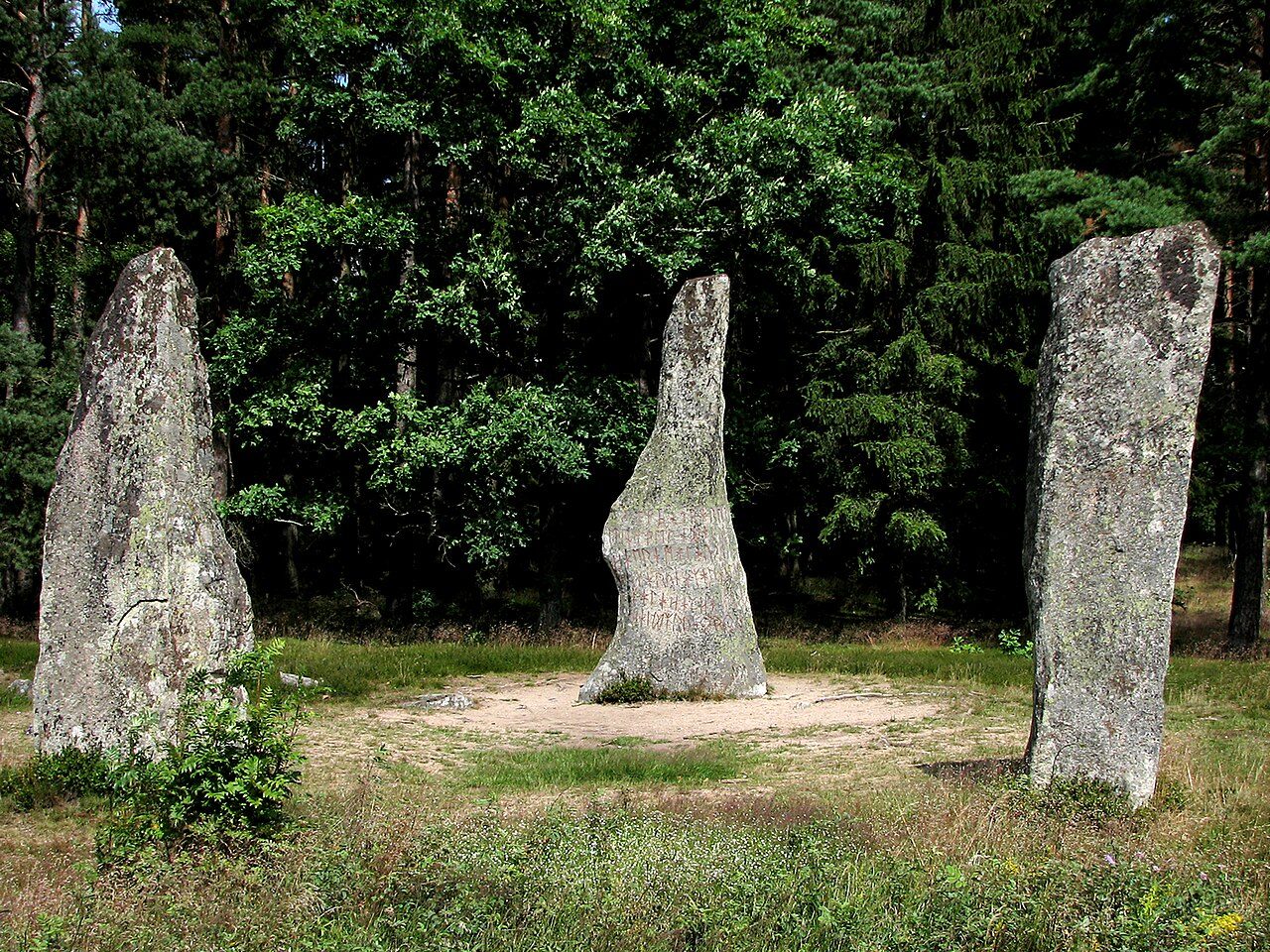
About 3,000 of the roughly 6,000 known Scandinavian runic inscriptions are runestones, and most were raised between about 950 and 1100. Sweden has the most (between 1,700 and 2,500 depending on how they are counted), with the densest concentration in Uppland; Denmark has about 250 and Norway about 50. Most follow a formula: X raised this stone in memory of Y, his father. Behind the formula are real people and their claims: inheritance, land, journeys to the east or to England, and, increasingly, conversion. Crosses and prayers such as "God help his soul" appear on many 11th-century stones, and the boom in stone-raising coincides with the arrival of Christianity in Sweden.
The Jelling stones show the formula at royal scale: King Gormr's memorial for his wife and King Haraldr's for his parents, which claims he "made the Danes Christian". The Rök stone, with the longest runic inscription anywhere, shows how much more a stone could hold. Scandinavians abroad left runes too: on the Piraeus Lion, on the parapet of Hagia Sophia in Istanbul, on crosses on the Isle of Man, and in the chambered tomb of Maeshowe on Orkney.
The Middle Ages: an everyday alphabet
Runes did not die with the Viking Age. In the 12th and 13th centuries Scandinavians added dots and new forms until there was a rune for every Latin letter (the medieval runes), and they used them for Latin prayers, Norse verse, business and personal messages. The richest evidence came from the excavations after the 1955 fire on the wharf of Bryggen in Bergen, where several hundred rune-sticks turned up: merchants' labels, IOUs, love notes and lines of poetry. A whole law code, the Scanian Law, was copied in runes around 1300 in the manuscript known as the Codex Runicus.
After the Middle Ages
Runes were used on perpetual calendars (runic staves) into the 17th and 18th centuries, and in the Swedish province of Dalarna a local runic alphabet, the Dalecarlian runes, was still being written in the 19th and early 20th centuries. Meanwhile antiquarians made the runes an object of study: Johannes Bureus in Sweden and Ole Worm in Denmark, whose Danicorum Monumentorum libri sex (1643) recorded the Danish runestones. Bureus also began the tradition of reading mystical meanings into them, which is told on the page about modern rune meanings.
Nineteenth-century nationalism made runes a symbol of the Germanic past, and the Nazi movement took runic signs for its own emblems, which is why some of them are still used by extremist groups and why some countries restrict their display. Runes also reached a wider public through fiction: J. R. R. Tolkien, a professor of Old English, used Anglo-Saxon runes on the map in The Hobbit (1937). Real runic research continues at universities in Scandinavia, Germany and Britain, new finds are published every year, and the inscriptions are catalogued in the Scandinavian Runic-text Database.