

What to notice
- About 760 runes: the longest runic inscription on stone
- Short-twig runes, Elder Futhark runes and cipher runes on one stone
- A stanza about Þjóðríkr, probably Theodoric the Great, who died in 526
- ᛧ (R) still distinct from ᚱ (r) in runaR þaR
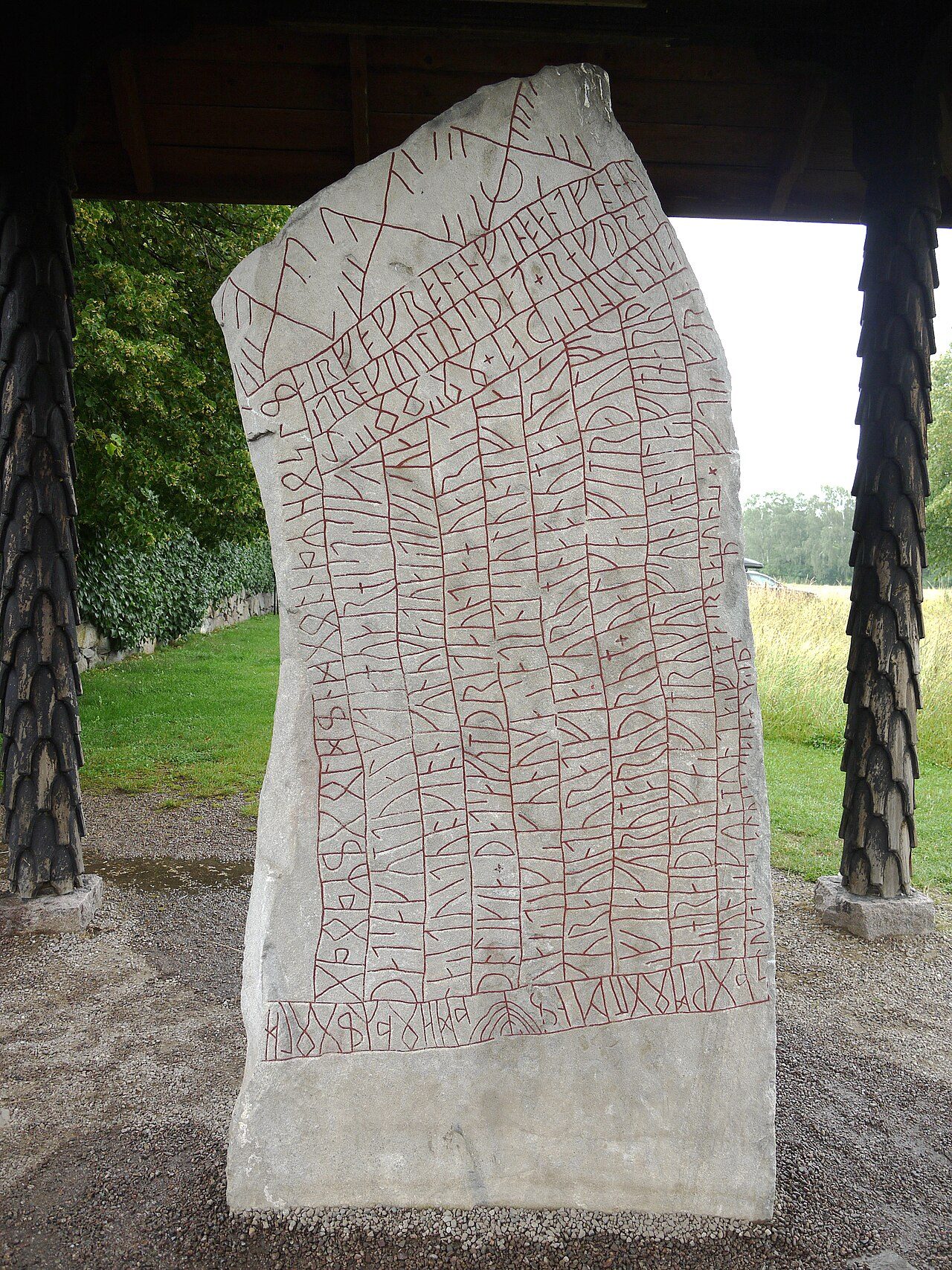
The Rök stone stands beside the church of Rök, near Lake Vättern in Östergötland, Sweden. It is a slab of granite about 2.4 m high above ground, covered with runes on five faces, the longest runic inscription on stone anywhere. It is usually counted as the first work of Swedish literature.
History of the stone
In the early 17th century the antiquarian Johannes Bureus found the stone built into the wall of a tithe barn next to the 12th-century church, with only one face visible; he published a drawing in 1624. When the old church and barn were pulled down in 1843, it was found to have runes on every side. In 1862 the stone was taken out of the wall and raised by the churchyard wall, and in 1933 it was moved to its present spot just outside the churchyard and given a roof.
The text
The inscription opens as an ordinary memorial: "In memory of Vámóðr stand these runes. And Varinn painted them, the father, in memory of his doomed son." Then it turns into something else. A series of statements, each introduced by sakum, "I say" or "let us tell", poses questions: which two war-spoils were taken twelve times; who died nine generations ago with the Hreiðgoths. A verse stanza in the meter fornyrðislag describes Þjóðríkr, "chief of sea-warriors", sitting armed on his horse, usually identified with the Ostrogothic king Theodoric the Great (died 526) and his equestrian statue, which Charlemagne moved from Ravenna to Aachen in 801. Later sections speak of twenty kings on Sjólund, the horse of the valkyrie Gunnr, and, in the last lines, of Þórr. The first part of the text has been analyzed as verse in the meter ljóðaháttr, so the stone contains early examples of both main Eddic meters.
Runes and ciphers
Most of the text is in the short-twig form of the Younger Futhark, the economical 16-rune row of Viking Age Sweden. Toward the end the carver switches to the older 24-rune Elder Futhark and to several kinds of cipher runes: runes replaced by their position in the row, or shifted one place. These are among the earliest examples of runic cryptography and show that the Elder runes were still known, as a learned script, in the 9th century. The rune yr, here written R, still marks a sound distinct from r (in runaR and þaR), a feature of the language that later disappeared.
Why it matters
Rök is the richest single source for Viking Age language, verse and runic learning. Its date, early 9th century, is set by the runes and the language, which are older than those of most Viking Age stones. The stone shows that a father in Östergötland around 800 could combine a memorial, heroic legend, myth and cryptography in one monument. Compare the bluntly political Jelling stones of a century and a half later.
The full reading
The main sections, after Rundata, in my own translation. Uncertain words are marked.
- aft uamuþ stonta runaR þaR n uarin faþi faþiR aft faikion sunu — "In memory of Vémóðr (or Vámóðr) stand these runes. And Varinn painted them, the father, in memory of his doomed son."
- sakum mukmini þat huariaR ualraubaR uaRin tuaR þaR suaþ tualf sinum uaRin numnaR t ualraubu baþaR somon o umisum monum — "I tell the people (or the young men) this: which two war-spoils there were, that twelve times were taken as war-spoil, both together, from man after man."
- þat sakum onart huaR fur niu altum on urþi fiaru miR hraiþkutum auk tu miR on ub sakaR — "I tell this second: who nine generations ago lost his life with the Hreiðgoths, and died with them for his guilt."
- raiþ þiaurikR hin þurmuþi stiliR flutna strontu hraiþmaraR sitiR nu karuR o kuta sinum skialti ub fatlaþR skati marika — verse: "Þjóðríkr the bold, chief of sea-warriors, ruled the shores of the Hreiðsea. Now he sits ready on his Gothic horse, his shield strapped on, prince of the Mærings."
- þat sakum tualfta huar histR si kunaR itu uituoki on kunukaR tuaiR tikiR suaþ o likia — "I tell this twelfth: where the horse of Gunnr sees food on the battlefield, where twenty kings lie."
- þat sakum þritaunta huariR tuaiR tikiR kunukaR satin t siulunti fiakura uintur ... — "I tell this thirteenth: which twenty kings sat on Sjólund for four winters, with four names, born of four brothers ..."
- The last part, partly in Elder runes and cipher, names Ingoldings, Vilinn, a giant and þur (Þórr), and ends sibi uiauari ul niruþR — "Sibbi of the sanctuary (?), ninety years old, begot (a son)."
What scholars agree and disagree on
Most of the runes are read the same way by all modern scholars; it is the meaning that is disputed.
- Heroic legend (Wessén 1958). Elias Wessén read the text as a sequence of allusions to heroic tales, with the memorial as frame. This was long the standard view and lies behind the text displayed at the stone.
- Vengeance (von Friesen 1920). Otto von Friesen saw a call to avenge the dead son.
- Riddle structure (Lönnroth 1977; Harris 2006). Lars Lönnroth and Joseph Harris read the questions as a riddle game in three parts, comparable to the greppaminni described by Snorri Sturluson; Harris also argued for a link between the dead son and myth.
- Climate and the end of the world (Holmberg, Gräslund, Sundqvist & Williams 2020). In Futhark 9–10, Per Holmberg and colleagues argued that the "war-spoils" are the sun and that the riddles concern light and darkness, with fear of a Fimbulwinter like the one after the volcanic events of 536 and the cold, red-sky events around 775 and 810. In this reading Varinn links his son's death to anxieties about the world's end. The interpretation has drawn wide attention and also criticism; it has not replaced the older readings so much as joined them.
- Þjóðríkr. The identification with Theodoric the Great is widely, though not universally, accepted.
- The name. Rundata gives both Vémóðr and Vámóðr for the son.
Sources
- Samnordisk runtextdatabas (Rundata), Ög 136.
- Holmberg, Per; Gräslund, Bo; Sundqvist, Olof & Williams, Henrik (2020), 'The Rök Runestone and the End of the World', Futhark: International Journal of Runic Studies 9–10, 7–38.
- Wessén, Elias (1958), Runstenen vid Röks kyrka. Stockholm: KVHAA.
- von Friesen, Otto (1920), Rökstenen. Stockholm.
- Lönnroth, Lars (1977), 'The Riddles of the Rök-Stone: A Structural Approach', Arkiv för nordisk filologi 92.
- Harris, Joseph (2006), 'Myth and Meaning in the Rök Inscription', Viking and Medieval Scandinavia 2, 45–109.
- Wikipedia, 'Rök runestone' and Swedish Wikipedia, 'Rökstenen' (for checking).
Readings are given as facts with their source; translations on this page are our own.