

What to notice
- 'that Haraldr who won all Denmark and Norway and made the Danes Christian'
- The oldest image of Christ in Denmark
- Text runs across three faces: read it by walking round the stone
- ᚼ for h and ᚬ for o, compared with Gorm's stone
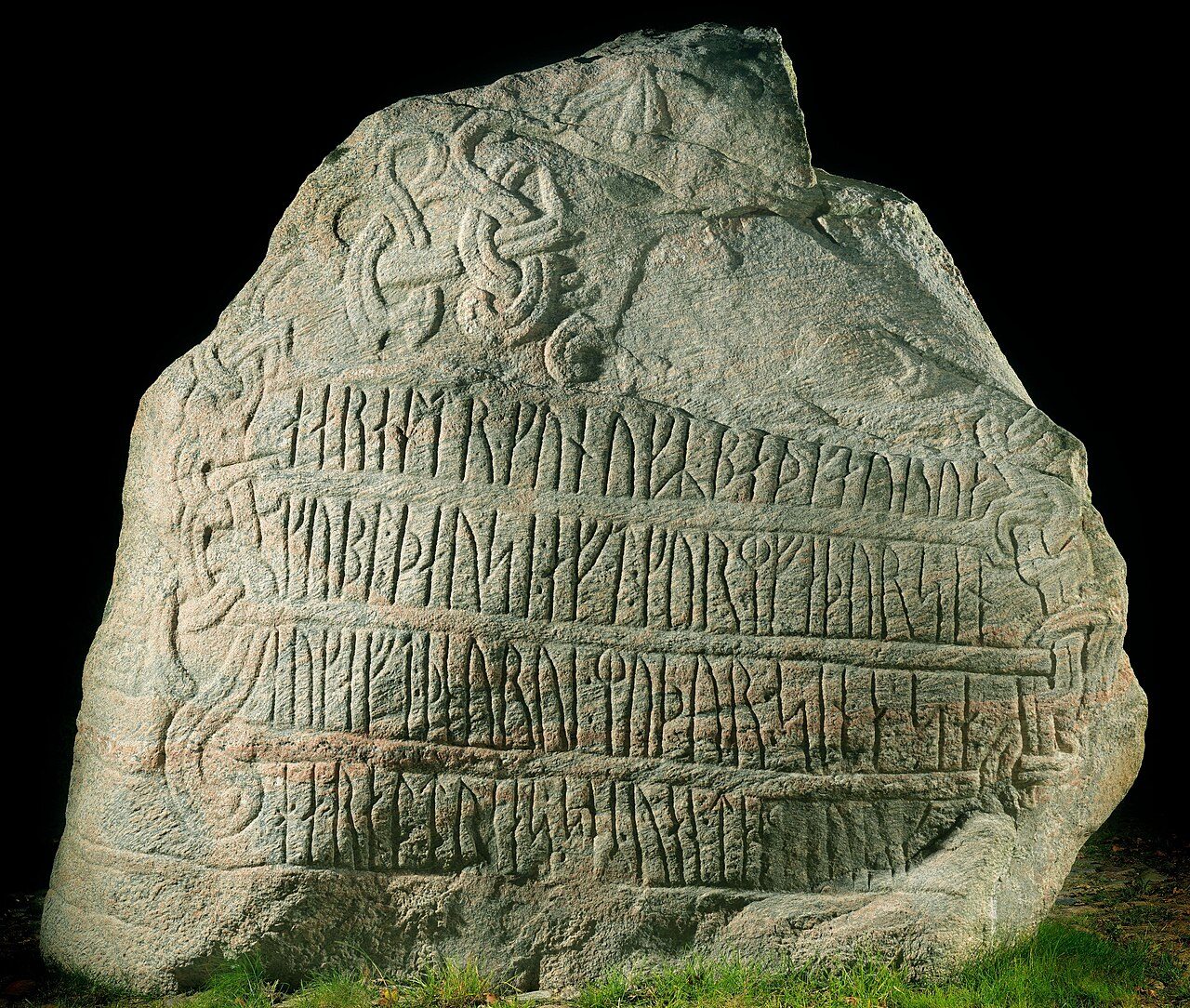
The large Jelling stone is a three-sided granite boulder raised by King Harald Bluetooth (Old Norse Haraldr) at Jelling in central Jutland. It stands beside his father Gorm's smaller stone, midway between two huge mounds, in front of the church. It is the most famous runestone in Denmark, often called "Denmark's baptismal certificate", a phrase coined by the art historian Rudolf Broby-Johansen in the 1930s.
A memorial that is really about Harald
The inscription begins in the standard way: "King Haraldr ordered this monument made in memory of Gormr, his father, and in memory of Þyrvé, his mother." Then it turns to Harald himself: "that Haraldr who won for himself all Denmark and Norway and made the Danes Christian." The memorial formula frames a statement of royal achievement: unification of the kingdom, rule over Norway and the official conversion. The text continues across all three faces, so the reader must walk around the stone, ending under the figure of Christ.
The images
Face A carries four horizontal lines of runes, an unusual layout for a Scandinavian stone, which more often place runes in bands. Face B shows a great four-legged beast, usually called a lion, entwined with a snake, in the Mammen style of Viking art. Face C shows Christ with arms outstretched, entwined in interlace instead of nailed to a cross; it is the oldest depiction of Christ in Denmark. The stone was originally painted. Painted copies stand in the National Museum in Copenhagen and elsewhere, and the Christ figure is reproduced inside Danish passports.
Runes and language
The runes are the long-branch Younger Futhark. Compared with Gorm's stone, Harald's carver uses hagall in the form ᚼ for h, and oss ᚬ for o (in þourui and soR). As on the small stone, kaun ᚴ writes both k and g: kaurua is gørwa, "to make", and kurm is Gorm. The final yr ᛦ marks the R in kunukR and soR.
Date and history
The German chronicler Widukind of Corvey reports Harald's conversion, which is usually placed in the 960s; Harald died around 985. The stone therefore belongs to roughly 965–985. Its claim about Norway refers to Harald's overlordship there in the 970s. Archaeology at Jelling has shown that Harald also built a vast palisaded enclosure and a ship-setting around the mounds, so the stone was part of a larger monument complex. A wooden church preceded the present stone church, and a reburied skeleton found under the church floor in 1978 has been suggested as Gorm moved from the north mound, though this is not proved.
Why it matters
Harald's stone marks the shift from pagan to Christian monumental culture in Scandinavia and announces the Danish kingdom in writing. It set a model: many later runestones in Denmark and Sweden combine a memorial formula with a statement about the sponsor and a Christian sign. Compare the purely familial memorial on Gorm's stone and the riddling learning of the Rök stone.
The full reading
Face A (four lines)
- haraltr kunukR baþ kaurua kubl þausi aft kurm faþur sin auk aft þourui muþur sina — "King Haraldr ordered this monument made in memory of Gormr, his father, and in memory of Þyrvé, his mother;"
- sa haraltr ias soR uan tanmaurk — "that Haraldr who won for himself Denmark"
Face B (under the great beast)
- ala auk nuruiak — "all, and Norway"
Face C (under the figure of Christ)
- auk tani karþi kristno — "and made the Danes Christian."
What scholars agree and disagree on
The reading is secure (Rundata DR 42; Jacobsen and Moltke 1941–42). Discussion concerns history and interpretation.
- Date. Between the conversion (960s) and Harald's death (c. 985). Some scholars place the stone early in that range, others link its claim about Norway to the 970s and date it later.
- "Won all Denmark". Whether this means first unification of Danish territory, reconquest after conflict, or control of areas such as Skåne and the islands is debated.
- "Made the Danes Christian". Historians agree the conversion was a long process; the stone records a royal claim, not a completed change. Widukind's account of the cleric Poppo and the ordeal by hot iron is the main written source for Harald's own conversion.
- Gorm's burial. The north mound contained an empty chamber dated by tree rings to 958–959; the remains under the church have been interpreted as a translation of Gorm into Christian ground, a hypothesis not universally accepted.
- Wikidata error. Wikidata currently gives this stone the signum DR 41; in Rundata DR 41 is Gorm's stone and DR 42 is Harald's.
Sources
- Samnordisk runtextdatabas (Rundata), DR 42.
- Jacobsen, Lis & Moltke, Erik (1941–42), Danmarks Runeindskrifter, no. 42. Copenhagen: Munksgaard.
- Widukind of Corvey, Res gestae Saxonicae III.65 (on Harald's conversion), public-domain Latin text, cited from general knowledge.
- Wikipedia, 'Jelling stones' (for checking).
Readings are given as facts with their source; translations on this page are our own.