

What to notice
- 'The man most skilled in runes west of the sea' and his borrowed axe
- 'Ingigerðr is the most beautiful of women'
- Jerusalem-travelers: probably Earl Rǫgnvaldr's crusaders of 1151–53
- Norse runes in a tomb already about 4,000 years old
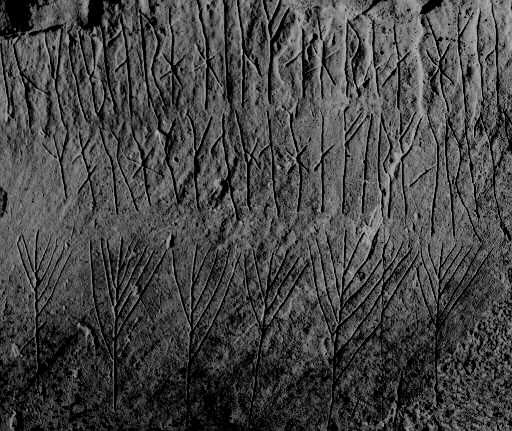
Maeshowe is a Neolithic chambered cairn on Mainland Orkney, built around 2800 BC: a grass mound covering a stone passage and a high corbelled chamber, aligned so that the midwinter sun shines down the passage. About four thousand years after it was built, in the 12th century, Norse visitors broke in through the roof and cut runes into the walls of the chamber. With about thirty-three inscriptions by many hands, Maeshowe holds one of the largest groups of runic inscriptions from a single place outside Scandinavia.
Rediscovery
The modern opening was in July 1861, when the antiquarian James Farrer, MP for South Durham, broke through the top of the mound and cleared the chamber. He found the walls covered with runes and published drawings soon after. The standard edition today is Michael P. Barnes, The Runic Inscriptions of Maeshowe, Orkney (1994), and the inscriptions are usually cited by Barnes's numbers.
What the graffiti say
The inscriptions are informal, written by visitors with time on their hands. Several are carvers' boasts: "These runes were carved by the man most skilled in runes west of the sea, with the axe that Gaukr Trandilsson owned in the south of the land" (no. 20); "Hermundr Hard-axe carved runes" (no. 19). Some are about women: "Ingigerðr is the most beautiful of women" (no. 21), and the teasing no. 9, "Ingibjǫrg the fair widow. Many a woman has gone stooping in here. A great show-off." Several speak of treasure: "In the north-west great treasure is hidden" (no. 25), "Happy is he who can find the great riches" (no. 27), "Hákon alone carried treasure out of this mound" (no. 28). Others name the mound and its supposed builders, the sons of Loðbrók (no. 23). Beside the runes are carvings of animals, including a well-known dragon or lion.
The crusaders and the saga
Inscription no. 24 reads "Jerusalem-travelers broke open Orkhaugr." Orkahaugr is the mound's Old Norse name. Earl Rǫgnvaldr Kali of Orkney led a pilgrimage and crusade to Jerusalem in 1151–1153, and the Jerusalem-travelers are usually linked with his company. Orkneyinga saga separately tells that at midwinter, probably in 1153, Earl Haraldr Maddaðarson and his men took shelter in Orkahaugr during a snowstorm, and two of them went mad there. These links give the inscriptions a date around the 1150s, though not all were cut at one time.
Runes
The runes are the Norwegian form of the Younger Futhark used in the 12th century, with dotted runes for sounds such as e and y (see medieval runes). Several carvers show off with twig runes and other cipher forms, and no. 20's claim to be the best rune-carver "west of the sea" fits that display. The Gaukr Trandilsson of no. 20 is a character in Icelandic tradition who lived some two centuries earlier, so the axe, if real, was an heirloom.
Why it matters
Maeshowe is the largest body of runic graffiti from the Norse settlements in the British Isles. It records spoken language, humor and gossip that formal runestones leave out, and it shows Orkney's place in the 12th-century Norwegian world. Compare the everyday rune-sticks from Bryggen in Bergen.
The full reading
Selected inscriptions, numbered as in Barnes (1994) and Rundata (my translations):
- No. 9 — ingibiorh hin fahra ækkia / môrhk kona hæfer faret lut in her / mihgil oflate / ærlikr — "Ingibjǫrg the fair widow. Many a woman has gone stooping in here. A great show-off. Erlingr."
- No. 19 — hærmuntr harþeksi ræist runar — "Hermundr Hard-axe carved runes."
- No. 20 — þisar runar rist sa maþr er runstr er fyrir uæstan haf mæþ þæiri øhse er ate gaukr trænils sonr fyrir sunan lant — "These runes were carved by the man most skilled in runes west of the sea, with the axe that Gaukr Trandilsson owned in the south of the land (Iceland)."
- No. 21 — igikærþ ir kynæna in uænsta — "Ingigerðr is the most beautiful of women."
- No. 24 — iorsalafarar brutu orkhaug hlif matselia ia=rls ræist — "Jerusalem-travelers broke open Orkhaugr. Hlíf, the earl's housekeeper, carved."
- Nos. 25–28 (treasure) — "In the north-west great treasure is hidden." "It was long ago that great treasure was hidden here." "Happy is he who can find the great riches." "Hákon alone carried treasure out of this mound."
What scholars agree and disagree on
- Dating. Most scholars, including Barnes (1994), date the inscriptions to the mid-12th century, with the Jerusalem-travelers of no. 24 as the anchor. Whether all were carved during one or two visits or over a longer period is debated; differences in rune forms suggest several occasions.
- The treasure. Whether the mound ever held Norse treasure is unknown. Excavation showed that the outer bank was rebuilt in the 9th century, which some archaeologists take as evidence of Norse reuse of the mound, perhaps for a burial that the 12th-century visitors robbed; others see the treasure inscriptions as jokes.
- Readings. A few inscriptions are damaged or written in twig runes and have uncertain readings; Barnes gives cautious readings and several alternatives. Some words, like ofláti "show-off" in no. 9, are clear but their reference is not.
- The saga episode. The Orkneyinga saga story of the snowstorm is literary and may not describe the same visit as the runes.
Sources
- Samnordisk runtextdatabas (Rundata), Br Barnes1–33 (Maeshowe).
- Barnes, Michael P. (1994), The Runic Inscriptions of Maeshowe, Orkney (Runrön 8). Uppsala: Institutionen för nordiska språk.
- Orkneyinga saga (public-domain Old Norse text), on Orkahaugr.
- Wikipedia, 'Maeshowe' (for checking).
Readings are given as facts with their source; translations on this page are our own.